Randy died on Tuesday. Head-on collision on a two-lane road, just outside of Channing. They say he drifted out of his lane, though why is a mystery. He had just dropped off his wife at the airport in Amarillo. He wouldn’t make it back home.
Randy finished his life at 45.
Moments such as this, especially those unwelcome or unexpected, are one of the reasons I believe we capture and preserve pictures. The fact that we’re able to look back when we wish and, with a little visual help, remember happier times is an authentic privilege never felt more pronounced than after we’ve lost someone, notably someone lost too soon. The picture never lies, reliably tells us the same story every time, and returns us to a single moment when that person we love was still with us and the world felt right.
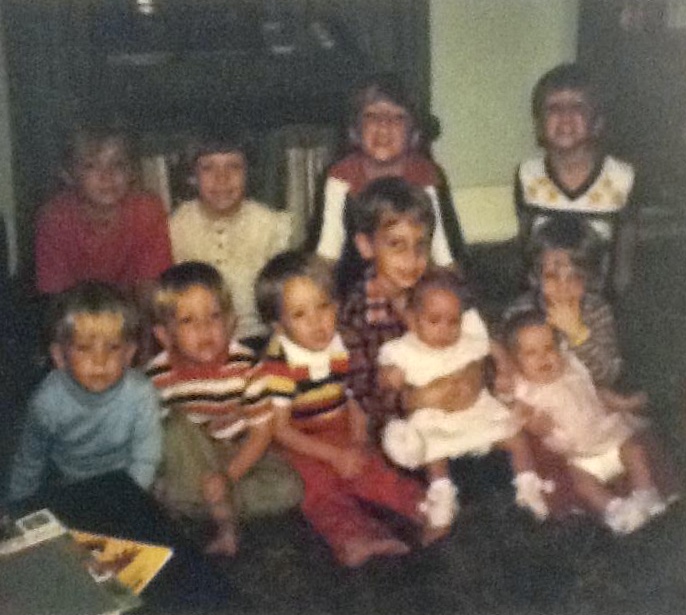
An old, grainy photo from nearly 40 years ago in Dalhart, our grandparents’ home, suggests the grown-ups successfully managed to keep all eleven Johnson cousins together and still for the brief time it takes the shutter to click. We’re all there, from the bottom left and moving counterclockwise, Rusty, Robert, Ashley, Jimmy, Stacy, Amber, Chad, Trey, David, Michaelene, and, finally, Randy. Allison, Stephanie, and Jeremy are absent but would join us a few short years later.
Each of us sitting stationary in the shot, looking ahead, have no idea what actually lies ahead, and I doubt any of us concerned ourselves at the time with that or anything other than moving on to play or to get into trouble, or both, for that matter. None of us know what we’ll grow up to be, who we’ll be with, or how many kids we’ll have ourselves to force into sitting still for group photos. Concerns such as that were for the adults; we just had to be kids.
Back here in the future, we’ve all made it to adulthood, to our chosen professions, and have picked our significant others. We each have our kids and take more photos of them than necessary thanks to the ubiquity of cameras and abundant storage. Our busy, full lives have taken us all in different directions. Consequently, it’s rare that we ever have moments for all of us to be together again, even if only for an afternoon. And that’s what makes me sad — with Randy now gone, the opportunity to reconnect, to make up for lost time, to take just one more picture of all of us together, is gone as well, and it isn’t going to return.
Randy and I didn’t know each other well, and I can’t recall the last time we spoke to one another. Regardless, there came a moment when it hit me that he is gone, that there wouldn’t be another chance to change that. He was family, after all, and that was enough to feel the loss as acutely as if it were a close friend.
He didn’t come to my mind that morning, but I nonetheless wonder what he imagined that day would bring. There was plenty, I’m sure that felt routine and uneventful. Even driving from one place to the next shouldn’t have given him a second thought. He couldn’t have known, waking up to the day, that there wouldn’t be another. In a way, I wish he had known, if only for closure. No time to say goodbye.
No, we all expected years further into the future when old age and its associated setbacks would naturally claim each of us Johnson cousins gradually, one at a time, long after we had laid our parents to rest. Only then would we later attend each other’s funerals after nature had taken its course. That’s the plan. But that’s not the story, it would seem, and it feels unfair. We’ve lost something — rather, someone — that we can’t replace.
John Donne famously wrote, “each man’s death diminishes me.” I can’t help but notice in the poem that he doesn’t specify more about the “man” or the nature or depth of the relationship. It doesn’t matter. We all are less for the loss, regardless; yet the bell tolls all the more profoundly for family.
Fun librarian fact: employing in a title the word “Webster” bestows no actual authority upon a dictionary. Any reference book publisher can make free use of the surname without fear of reprisal, and many have done so for no other reason than monetary gain, unbeknownst to the masses. If you want the original, bonafide article, history bears out that Merriam-Webster is the way to go. You’re welcome.
That being said, Merriam-Webster defines epistemology as “the study or a theory of the nature and grounds of knowledge especially with reference to its limits and validity.” If that sounds confusing, don’t stress over it. By and large, career philosophers, rather than bricklayers or bakers, devote themselves to this weighty topic. It’s not for the faint of mind, so to speak. Many a green student ushered into academic ivory towers past or present, as even I’ve witnessed first-hand, has found himself or herself questioning everything from the existence of God to proper footwear due to the lack of a quick and easy answer to one of the most fundamental questions of epistemology: “How do I know that I know?”
I’ve known myself long enough now to understand that abstract thought is hardly my forte, but I dabbled for a time in my collegiate years, as many have, with the troubles this question raises for long-standing beliefs or convictions. At some point, I don’t remember when, I found a way to move past it, live with the fact that I’d likely never plumb its depths, and allow the philosophers to do their worst. Nonetheless, my struggles with this question and its answer arose for me once again in a different form several years later for a more down-to-earth and personal concern, though no less impactful for a future I hoped for.
One early fall, finishing up a mid-day run at a nearby park, I stepped back inside to the house my parents, brother, and I were renting together. We all were under the same roof after the two of them returned to Texas the previous year to begin pursuing a change in career after exiting professional ministry. I had a few months left of grad school before I was off to the races with my own chosen career. In the meantime, my father and I each had jobs that employed us in downtown Fort Worth from early afternoon to midnight, allowing us to carpool together.
Sweaty and exhausted, I planted myself on the white brick hearth in front of the fireplace. My father sat in the recliner reading a book, still his favorite pastime. Slowing my body down, I slowed my thoughts as well. Resigned no longer to fight it, I expressed one simple truth I had been ignoring for most of the year.
“The only thing I’m sure about is that I’m not sure about her.”
My father-in-law, characteristically loquacious, when asked the secret to a long and happy marriage, manages to keep it simple: “Choose well.” I wouldn’t hear this advice, however, for at least another eight years. Instead, after a pregnant pause, I heard the laconic response of my own father, glancing up from his book, decidedly and calmly encouraging action. “Well,” he said, “you may want to do something about that.”
In far less than a year’s time, I had met, dated, had become engaged, and was about to be married to a woman I had persuaded myself, against my better judgment, was someone I loved enough to spend the rest of my life with. But once the dubious words escaped my mouth, it was clear they left along with a weight I had been unwittingly carrying. That alone spoke volumes. Relieved for the first time in months, I exhaled. On the heels of this brief respite, however, was my father’s bittersweet advice. I was about to ruin someone else’s day.
From the moment I was old enough to be legitimately interested in the opposite sex, I knew I one day wanted to be married. Granted, the vast majority of us ultimately seek out a partner, though with varying results. I knew this, though, the way some know at a young age that they want to be a doctor, a minister, etc. They feel it in their gut and single-mindedly pursue it until it becomes destiny fulfilled. The fanciful idea of “the one” — a divinely-selected, perfect person out there, somewhere, with whom you’re meant to be — was more than merely an appealing idea for me. But as the attempts failed, as friends around me found their partners, and, now, as I was about to abandon my best hope thus far, the idea began to sound ridiculous. Just pick someone, already.
As painful and difficult as it was, I never, in the years following, regretted calling it off. I couldn’t explain it epistemologically, but of what little I did know, it was clear she was not “the one,” if such a person existed at all. In the nick of time, I walked away confident of the decision, though I had wished for better.
I’ve asked God more than once for just a peek into the future, just a tiny glimpse to assuage my worry that things won’t work out, that this longing, this hope, for an imminent turnaround for the trouble of the day could rest on anything other than the quaint concept of “faith.” More often than not, though, this, along with the promise of Romans 8:28, is the pill we have to swallow to find any peace in where we are right now.
It would take several more years of seemingly fruitless eharmony matches, setups, and dates, blind or otherwise, before I ran into the person I’ve called my wife the past 9 years. It would also take us at least a couple of years after meeting for us to begin to realize that our casual and comfortable friendship was the catalyst to wake us up to the possibility that we might be better off together for the remainder of our our lives rather than apart. As women often do, she figured this out long before I did. And as I’ve mentioned before, she’s got her goals, and I unknowingly made the list. Thank God for the virtue of patience, because I didn’t make it easy for her.
Which brings me back to the question I expect my kids may ask one day when they’re facing a similar prospect: How or when did I know?
You may have your own answer to this one. I know exactly where I was when found mine.
Standing in my girlfriend’s driveway one evening and saying goodnight, the question came up.
“So, where do we go from here?” she asked.
I had spent little time formally pondering the question over the last year to fashion an eloquent answer. We had become very accustomed to day-to-day life together, which was fine with me. I wanted anything but the rush and desperation of my previous engagement to ruin this. So, she bided her time, thankfully. But it was now time to take a look back in order to see the way forward.
It must have only taken a moment, but it occurred to me — each of our thoughts drift effortlessly into what we’ll be doing later in the day, tomorrow, maybe a week or a month from now. Call it daydreaming, if you like, but we all do it. Whether deliberately or not, our minds habitually attempt to prepare us for whatever lies ahead, even the mundane or everyday tasks. And that’s when it hit me. Seamlessly through the course of our relationship, when I stopped to take a closer look, she had almost imperceptibly slipped into such thoughts. Whatever was happening tomorrow or a year from now, she was now present there with me, quite as naturally as any of my four limbs would be; so natural, in fact, it almost didn’t bear mentioning.
“Well,” I said, without the reservations of my previous engagement, “I guess we’re getting married.”
And so we did the following year.
The excitement and romance of the early days and years of marriage give way eventually to the routines of life. The end of the honeymoon, so to speak, can disillusion some couples. My wife and I don’t recall a moment when that occurred for us; we were friends long before we saw our way to something deeper, but I understand some do find themselves there. Regardless, I still believe in the idea of “the one,” though not as I used to.
Scripture is replete with examples of God bringing individuals to one another for a greater purpose. Jesus himself, on the subject of marriage/divorce, famously reminded his audience, “What God has joined together . . .” It’s in there and it’s hard to get around if you believe it could be anybody and that it’s all up to you, which you’re welcome to; it would seem there isn’t anything stopping you. But I think if we allow it, God can and does guide us to someone, if we let him and if he so desires it.
It’s hard for me to imagine, after all my effort, that there could have been anyone else other than my wife better suited for me. But I also believe that doesn’t mean that I couldn’t sabotage “what God has joined together.” I certainly could. Being “the one” for someone, and vice versa, still carries with it responsibility to care for what you’ve been given and to continue demonstrating that you are the right person.
Moreover, if I’m not perfect now, I certainly wasn’t perfect then. There’s a lesson there for my former self, on the cusp of the wedding. Being “the one” for each other doesn’t a perfect marriage make. There is still work to be done and a relationship to be maintained. But it does mean, if you believe it, that you were put together for a reason.
My wife and I didn’t venture into Hollywoodesque “happily ever after.” It makes for a great matinee, but it needs to be put to rest in real life. Happy? Yes. Ever after? Not all the time. But I still believe “the one” isn’t an empty idea but a lofty one, more providential than merely romantic, and I would gladly allow us to be picked for one another once again.
It struck me while I was shaving. It escapes me why I hadn’t taken solemn notice of the change before then. Staring incredulously at myself in the mirror, it suddenly occurred to me, a month or two beyond my birthday, that I was now a 30-year-old man.
In my 20s, I still felt, at best, a “young” man. Mistakes, missteps, and immaturity could still be dismissed to the inexperience and naïveté of youth. I had an excuse for stupidity.
But I had never before imagined what 30 might portend for me. I grew up having been told about an uncle I never had the opportunity to meet due to having tragically met his end in his 20s. Somehow, he had survived the terrors of Vietnam as a forward observer in the Marines only to meet his fate at the hands of a drunk driver not but a few miles from home. A head-on collision returning from work, and it was all over. I was given part of his name in his memory once I was born a few years later. As a superstitious teenager, I feared sharing his name might mean I would share his fate. I consequently didn’t spend a great deal of time thinking about what to expect past three decades.
“Huh. So, this is what 30 looks like,” I expressed to myself. I had never experienced a formal rite of passage as a teenager, as in a bar mitzvah or something similar. This felt like such a moment, however, minus the festivities and religious underpinnings. Unceremonious and anti-climactic, but unmistakable — I was now a “man.”
I have yet to live every decade most men and women, by God’s grace, are permitted to be considered a “full” life span. But I have to say, one’s 30s, in my humble opinion, should by no means be wasted, and for good reason. Though there are always exceptions, most of us still have bodies that are not yet showing pronounced signs of age, allowing us to enjoy common and even vigorous forms of physical activity. There is likely still more of life ahead of us than behind. Many of us have finished school by the beginning of our third decade and are surging forward expectantly in our careers, but we may still have the flexibility of changing course if desired. There may be loans to pay off, but you are, for the most part, financially independent. For many, kids may have entered the picture, and they decidedly alter life plans. But all things considered, there is no place like one’s 30s.
I should mention that I’m observing all of this from the proverbial peak of the hill, granted I make it to 90 (which I’m not sure I want to; old age looks like anything but a party to me). I didn’t make time to reflect on “40” once it hit, and I never truly have. I expect, though, that 50 will be a similar moment to 30. How ponderous, after all, is it to say that you’ve lived half a century?
In any event, in my 40th year, the kids boarded the ship, and off we went. I haven’t had an abundance of time since to stop for hours and take in the view.
What you begin to notice in your 40s is that your body, notably, isn’t as forgiving of the poor choices you make. Taking care of it can start to feel like an uphill battle. Having more dessert, or more of anything ingestible, for that matter, is almost never a good idea. The doctor tells you that this is too high or that’s too low, so take some of this, which, you realize, is currently in your parents’ medicine cabinet. That can’t be right, because they’re old, after all. Your brain may start playing tricks on you as well, especially if you don’t exercise it. Names evade me more frequently than they used to, even those of whom I am well-acquainted. Maybe that expanding bald spot at the crown of my head has something to do with that. Wait — are those white hairs in my beard?
Kids accelerate the progress of years, I’ve found, as many of you have as well. “The days are long, but the years are short,” I once heard someone sagely remark about raising children. I’m not sure why this is, but I can’t help observe that the passage of time while growing up before one moves out seems much longer than it does when one is parenting over the same span. “You blink your eyes one day and they’re gone,” more than one empty-nester has remarked to me. On the hardest days with them, I admit I sometimes think that day can’t come soon enough, though I admit the last five years have flown by; they’ve changed so much.
With age, even the slow days, collectively, are faster than they once were. Our middle daughter and I recently finished a 10-day COVID quarantine at home, alone, after she became infected at summer camp. Naturally, we did very, very little of consequence during that time — which is just another way of summing it up as “boring,” as she would unapologetically describe it. Nonetheless, I found that the evening each day came on sooner than I would have expected.
Fast or slow, the years are here and then gone. There are gains as more of it passes, but there are inevitable losses as well. I can take the fact that I’ll lose a few things along the way and have even begun to, namely physically and mentally. I feel somewhat prepared for that. It’s the loss of time, however, and especially the less of it that’s available that gives me pause.
Many decades ago, songwriter Jim Croce crafted his song “Time in a Bottle.” A brief tune, the memorable melody alternates between haunting and hopeful. “There never seems to be enough time to do the things you want to do once you find them,” he shares in the chorus. His inspiration for the song, I understand, was the birth of his child and the realization that, in spite of the fact that it would seem they had many years ahead to spend together along with his wife, their time would ultimately have an end. Little did he know how true this would be. Like the uncle I never met, Croce tragically and prematurely met his end. Only 30 years old, he and those with whom he was traveling died instantly when, on their way to a performance, their plane collided into a tree shortly after takeoff.
The reality of death makes life itself all the more precious and meaningful, they say. I like to think Croce’s life, though not “full” in the sense of the span we all hope for, was not wasted if for no other reason than that he left us with verses that ask us to pause and learn to value the time we are given. He did not live to raise the child who, in part, was the muse for his song, but his time was used well and and his talent wisely.
“Teach us to number our days, that we may gain a heart of wisdom.”
I don’t know if Croce was a religious man, but I imagine this verse could have served as further inspiration for a song such as this. It’s one of a select few verses pinned on my work cubicle wall in an attempt to remind me of something I so often forget but will be ever more important as the days, months, and years move along: your time is limited, so use it wisely.
Were I to number the days that I’ve wasted time, I’m certain I’d lose count. I could say the same for the days I phoned it in or failed as a parent. I worry at times how the kids will remember me once they’re grown or how my influence on them will be beneficial or detrimental. None of us is perfect; we figure this out never more quickly or viscerally than as parents.
I remember few of my parents’ mistakes with my siblings and me, though I know they would say they committed more than a few; almost any parent would echo such a sentiment. But just as the reality of reaching my third decade struck me while gazing at myself in the mirror, it strikes me that I rarely, if ever, remember any parenting mistakes my own might have made.
“I thought my dad was tough on me, and now, looking back on it, I just remember the good stuff.”
No, I didn’t voice this quote myself, nor did I pull it from the pages of a book. Just for fun, I’ll leave it to you to trace the reference. But I pray it could just as well be uttered by any one of my kids years from now as they learn the wisdom of numbering their own days.
I don’t read as much as you would expect of a librarian. Granted, I do enjoy it, but for the last 5 years I’ve become more easily distracted by the TV, a nap, or just about anything else that offers a break from parenting. If I gave you two numbers that represented how many books either my wife or I read this year, you would guess wrong. She’s got some serious goals.
Nevertheless, I find time when I can. I recently read a novel in which the protagonist, disappointed about the unsuccessful and lonely state of her early adult life (in her opinion), found herself, after an attempt to end it, instead faced with the opportunity to try on other lives she could have led had she made one pivotal choice to move in a different direction. It wasn’t exactly a sci-fi approach of how things might change on a large scale, as in the parallel universes explored by, say, Star Trek or Marvel storytelling (see “Loki” on Disney+, for instance). No, this was more of a personal nature, as in “What if I had married so-and-so?”, “Should I have taken the opportunity to move over there?”, or “What if I had pursued that passion wholeheartedly?”
A form of this question came to my mind recently. As I write, I’m here at home with our middle halfway through a 10-day stay, just the two of us. To be more specific, we’ll be here together, alone, for the duration of a standard COVID quarantine period. Sparing too many details, it took literally many miles and much frantic maneuvering by my wife and me over an initial and unexpected 24 hour period to figure out how and where each of the five us, already spread out across the state, would place ourselves for the duration once it was discovered she tested positive very early into summer camp and I had to book-it to get her out of there.
As I drove the first few hours of the change, the sudden diversion in plans brought the question to mind: “What would I be doing if I didn’t have kids?”
Before you feel inclined to judge, a few clarifications: I have kids, and I don’t wish that I didn’t. We’ve shared many times with one another that the choice, for us, was inevitable, one way or another. We both would always have regretted not choosing parenthood. Also, once you meet or conceive them, you love them and worry incessantly about their present and future, God’s admonitions not to worry notwithstanding. Rather, this question is better phrased, “If the choice to have kids had never been made in the first place, knowing nothing of them or about the future as it is, what would life look like right now?”
My wife and I had four years together to enjoy the DINK lifestyle. And enjoy it, we did. Coming home from work or waking up to the weekend, I had plenty of “me” time, as did she. Go for a run? Sure. Cook dinner and watch your favorite show quietly together on the couch ? Of course. Randomly go out for a nice dinner in the middle of the week with other DINK friends? What’s stopping you?
Travel, namely, is one among many ways we seized the day. Never before or since have I been able to tell anyone, for example, that I would be joining my wife on her work trip for the weekend not across town or simply out of state, but in Belgium. We didn’t even have to arrange a pet-sitter for such a spur-of-the-moment trip.
So, I imagine we’d be doing any number of things. We’d likely be living in a different house, maybe even abroad. I’d be further along in a full-time career. I’d be making much more time to take better care of myself and wouldn’t have the dad-belly I’ve been successfully nurturing the past five years.
You don’t realize how much you take that time for granted until it’s gone. They aren’t “kidding” when they say kids change things. And once you’re in, no turning back.
Sacrifice is the name of the game with kids. And it’s hard. Sure, there are still plenty of pleasures to be had; but school, homework, trips to the doctor, soccer practice, positive COVID tests forcing you all to change your plans, etc., now take precedence. Take ample time for yourself later.
Not hard at all to imagine what you would be doing if it were only the two of you. Tempted to sigh longingly while pondering it over, I’m prodded into an even better question:
“Where would they be had you not chosen parenthood?”
Ouch.
“It’s not about you.” That’s how a well-known minister many years ago opened his bestseller. And I’m afraid he’s right.
Our three were adopted. Our kids weren’t always our kids. I have no way of knowing what life might have been for them had we not made this choice, but I understand it certainly may not have been idyllic or privileged. But that’s not a question they have to put to themselves. In fact, “What would I be doing if I didn’t have kids?” is a selfish question, I realize, and one which they wouldn’t want answered.
In the end, the protagonist of the story ended up almost right back in the life she left behind. There were other lives that were most certainly worth envying, but not one of them was perfect, and each had its drawbacks due to other choices not made. With a changed perspective and attitude, she made the best of where she was, not dwelling on where she thought she should or could be.
So, maybe it isn’t the best use of time to wonder what could’ve or might’ve been in various alternate versions. It seems to me such over-speculation makes a god out of our ability to choose. If you believe, as I do, that there is a God ultimately writing the story, then there’s something to his instruction not to stress or worry about the day to day.
I see I could be doing a lot of things were it just the two of us, and we’d likely enjoy ourselves thoroughly. I could choose a more comfortable life, a life more for myself. A lot of us choose that, and many of us think that’s what we are supposed to pursue. But it would be a life vacant of the opportunities and benefits — the love — I could provide to others.
Speculation aside, the reality is there are 3 kids who comfortably call us “mom” and “dad”, and I know for a fact they think it ridiculous that it could be any other way. Why should I, then, spend time imagining it differently? How they’ve been changed for the better by this choice is far more important than the choice I could have made solely for me.
God, give me rest from parenting when it’s needed, and help me to remember you’re writing the story. I need not worry about the choices I could have made nor remain in regret for those I have. Amen.