“Somebody donated these to the bookstore. I thought you might find a use for them.”
John Lottinville, one of several Friends of the Library board members and bookstore volunteers, reached across my office desk and handed me a set of old NASA prints of the Apollo 12 mission, released years ago and of no special value to anyone but a collector of early NASA memorabilia. John himself was a retired lawyer for the Johnson Space Center and retained a lingering esteem for the program, having met plenty of astronauts himself during his career, including those featured in the prints. I thanked him for the thought and took a closer look at his acquisition: over half a dozen cardstock prints each slightly larger than a legal-sized sheet of paper, featuring photos of various moments of the mission that followed the historic first landing.
Among the three crew members, which included mission commander Pete Conrad and command module pilot Dick Gordon, was lunar module pilot Al Bean — a wholly uninspiring name for a historical figure, in my humble opinion. He did, however, bear the distinction of having been the fourth man to set foot on the moon and was tied to Ted Freeman, whose memorial library I had, at the time, been managing for a few years.
“Ted Freeman“ isn’t a name many outside of NASA circles or fandom would recognize. Prior to 2004, I didn’t either. That was the year I began my professional career as a public librarian in Clear Lake, the southeast corner of Houston, in an updated facility named after an astronaut who, tragically, never had the chance to ride a rocket. It’s likely he would have been among those who would eventually find himself venturing into space or bouncing and gliding across the bright lunar surface, were it not for a bird strike that forced him to make the valiant yet fateful decision to avoid crashing his T-38 into residences below and veer off into open ground, undoubtedly saving lives in the process — save his own, that is.
Freeman and Bean joined NASA as a part of Astronaut Group 3, which included, among others, Buzz Aldrin and Michael Collins. As I studied the prints, I recalled this connection between the two of them. It then occurred to me that Bean was one of the few Apollo astronauts still living, and, as it just so happened, residing right here in the Bayou City.
Buzz Aldrin with Ted Freeman, October 30, 1964, one of the last photos ever taken of him. His T-38 accident occurred the following day.
I had found it fruitless in recent months to solicit a visit by an Apollo astronaut for the library’s 50th anniversary. Appearance fees for any of the most recognizable names are almost as lofty as the altitudes they reached during their missions, I learned, and public libraries are hardly blessed with the budgets of the many energy companies that envelop Houston. “Maybe I can’t persuade them to visit,” I thought, “but perhaps there’s another way to give the public at this library a closer connection to the program that began right here in their own neighborhood.”
I pivoted over to the computer, searched, and found that Bean, as many did, maintained a website, much of it featuring his art, a hobby he enthusiastically took up following his awe-inspiring trip to the moon. Clicking on the “contact” section, I punched in the details, noting Mr. Bean’s link to Freeman as a “classmate,” mentioning the acquired prints, and humbly requesting just a single autograph on only one of them so that they could be placed on permanent display for the public. My expectation after submitting the message was, in all honesty, to receive a response from an aide or site manager weeks later stating that Mr. Bean appreciates the request but would respectfully have to decline. I had read enough such polite refusals to expect nothing less.
Once and a while, however, persistence pays off. “Ask and ye shall receive.” A mere hour later, in my email inbox appeared a new message. Figuring it to be either an automated or stale, noncommittal response, I clicked, opened, and read the following casual reply as if the sender were texting a familiar friend:
Jim,
Can you send a picture of the prints?
Al
Now, few accomplishments top a trip to the moon. The first to attempt the journey were a uniquely capable breed of individuals who willingly risked their very lives to travel faster and farther than any humans in history. If any could be forgiven for possessing even a dim shade of an ego, they’d likely qualify. Yet, here I was, having been offered the special courtesy of a swift answer not by an assistant or secretary, but by the very astronaut who stepped out onto the lunar surface himself.
After taking a moment to register my shock that I was now engaged in an unexpectedly comfortable email conversation with a moonwalker, I gushingly replied with gratitude and haste, attaching pics of each and every print, offering to send them with a postage-paid return envelope. Within minutes, he again replied that he would be glad to accept my request and to send them his way to the provided address.
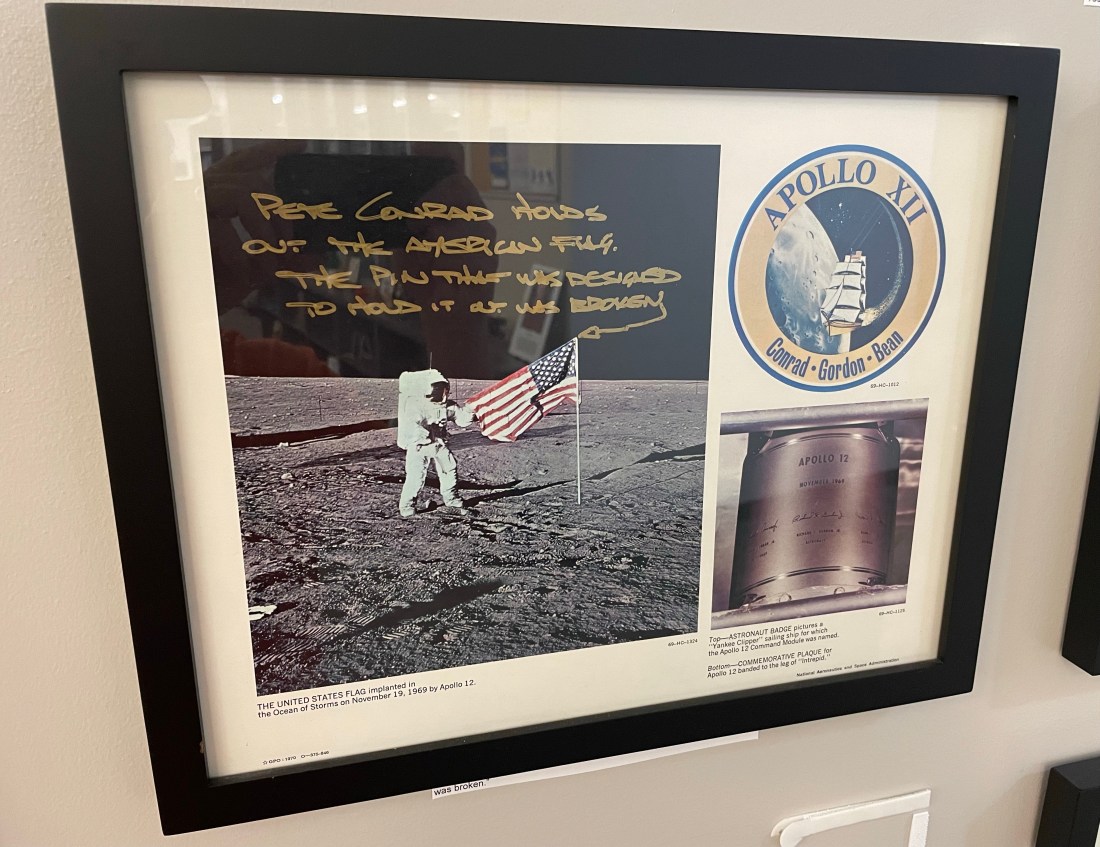
The following morning, I wasted no time and sent them on. I waited only a week for the large, prepaid envelope to return to me. Sitting at my desk, I carefully sliced open the narrow end expecting to find his autograph on the one print featuring his official NASA photograph with his crewmates. In this, I was not disappointed. But as I removed and laid out each of the remaining prints, I was delighted to find that Al had decided to do me one better.
On each of the others, featuring a photograph of his and Conrad’s activity on the lunar surface, he detailed by his own hand and in as much space as the print would allow what he and his commander were doing in the image at that specific frozen moment in time. I marveled at what I was seeing. I took great pleasure in realizing what a staggering gift this was to this library and how it would further cement its significant, local connection to the space program. Bean had been beyond gracious to share these with his deceased colleague’s memorial building, and I couldn’t have been happier.
One of several autographed prints by Bean on display at the Freeman Library. This one, a photo he snapped himself, reads: “Pete Conrad holds out the American flag. The pin that was designed to hold it out was broken.”
Bean passed away a few short years after this gift to the library. Today, these signed prints remain on display on the second floor for the public to enjoy, right next to an American flag carried into space on Gemini V by his friend and Apollo 12 commander, Pete Conrad. I never had another encounter with an Apollo astronaut, but it remains one of my favorite stories during my time managing the Freeman Library.
Living and working in Clear Lake, you run into plenty of NASA professionals, all with their own unique jobs but all with the singular goal of sustaining man’s presence in space. I became a fan not long after becoming employed by the county library and learning all I could about the first full decade of the program in the 60s. The astronauts themselves, both past and present, walk among us here, and I’ve found few of them carry themselves as if celebrities. I once paid my rent to a former astronaut, attended church with another, and even had occasional interactions with one who received an embarrassing share of national publicity for an unfortunate personal mistake. It’s easy to forget those few among us tasked with such important, high-profile jobs that deserve the title of “missions” also shop for groceries, pay bills, and argue with their teenagers, just like the rest of us.
Next year, after over 50 years, four crewmates in many ways just like the rest of us will return to the same moon Al Bean walked upon, and I couldn’t be more thrilled. The first landing is one of the only events in all of recorded history that drew the attention of the entire world. It’s my hope that once again, for at least a moment, there will be peace on earth as all eyes are fixed on the moon above.
I’ve shared with several that I’d be happy to sweep the floors at JSC just to say I worked for NASA. I continue to be inspired by their efforts to explore, take risks, and challenge what’s possible. Alas, they’ve never called to offer a job, but I’ve nonetheless been grateful to have worked in the library that serves the NASA community. I’ll likely in years to come bore my grandchildren and great grandchildren with the story of my email conversation with the fourth man to set foot on the moon.
Perched atop his elevated station, he attentively scans the distant, deeper waters with his binoculars for any signs of beachgoers in mortal peril. To say he is attractive is an understatement; the actor portraying a hyper-vigilant lifeguard was chosen for this very reason. His eyes soon land upon a shark closing fast upon a flailing, bikini-clad woman. Wasting no time or effort, he leaps from his chair and sprints toward the shore, plunging into the water, bravely heading off the deadly predator as he rains blows upon its head and body before it retreats, hungry and defeated. Victorious, he lifts and carries the exhausted, distressed damsel in his arms back to the safety of the sandy shore and gently sets her down. She regains her composure, sits up and gazes into her rescuer’s eyes as the two begin to lean in dramatically for a kiss. The message is clear: What woman wouldn’t fall instantly in love with such a man?
Not so fast. This is a super bowl commercial, after all, so, naturally, we’re waiting for the punchline in this million-dollar mini-drama.
And here it comes. Distracted, she glances to her right, and with as little hesitation displayed by her rescuer’s dash after her into the dangerous waters, she makes a beeline further into land, but for whom or for what? The camera pans as we catch a glimpse of an astronaut enveloped in a spacesuit, prepared not for a swim but for a spacewalk, strolling casually onto the sand as if this is typical attire for a day in the blistering summer sun. He removes his helmet as the enthralled woman pauses before him. The marketing slogan then appears on the screen, advertising a new line of “Apollo” themed body spray:
“Nothing beats an astronaut. Ever.”
As ridiculous as this scene is, I’m inclined to agree. After 18 years of living in and around the Johnson Space Center community of Clear Lake, you encounter enough astronauts, or those who work among them, to recognize that, in spite of all the promises and encouragement that the “American dream” is attainable if we simply work hard, believe, and hang on to said dream, virtually none of us will actually ever have the opportunity to reach for the stars. There is the “cream of the crop,” the “elite,” the top 10 percent, etc.; and then and only then, there are astronauts. Among the first class of recent Artemis candidates was a relatively young fella who had not only been a soldier in the U.S. military but had scavenged enough time as well to become a doctor, soon after having NASA agree to take him into the fold. As one politician put it, speaking at the first Artemis group introduction to the public, “This guy could kill you, bring you back to life, and do it all in space.”
If nothing beats an astronaut, I would venture to say that nothing beats Neil Armstrong. Back when test pilots were the pool from which the “right stuff” was summoned, Neil was the picture of quiet, capable discipline, unlike many of his colleagues, who, though equally qualified, were neither shy nor humble about their skills. There arguably was a reason he was the first to land and to set foot on the lunar surface, if it wasn’t due merely to being in the right place at the right time. He was there not to chase fame and fortune but simply to do his job, and he did it well, staying cool under pressure as the entire world watched. Both his accomplishments and his character easily suggest to anyone that this is someone whose words are worth heeding. He did, after all, have the distinction of uttering a few of the most memorable ever spoken with an audience larger than that of anyone previously in history.
A lesser-known moment in Armstrong’s history records a few more words once spoken, though decidedly more personal and candid: “I believe every human has a finite number of heartbeats. I don’t intend to waste mine running around doing exercises.”
It should be noted that for all his accomplishments, Armstrong, though living to the respectable age of 82, died post-surgery to correct coronary artery disease, which, it is known, can be prevented, or at least kept at bay, through regular exercise. One has to wonder how many more years it may have added to his life, if any, had he held a different opinion and adjusted accordingly. It certainly could have improved its quality, if not it’s length. In any event, something did, in fact, beat the most recognizable astronaut, and not even a difference of opinion could change it.
While Armstrong’s words were not founded in solid medical science, many of us live with poor daily habits that might imply we’re true believers, though I would guess it has less to do with bogus convictions about an allotted number of heartbeats and more to do with the lack of a quaint virtue lost to many of us in the comfortable lives we casually choose to lead: discipline.
In recent years, I admit to losing more than a smidge when it comes to food or finances, and especially exercise. I don’t know if it’s an effect of age or gaining greater privileges as one moves upwards in career, resources, and accomplishments, and I could blame parenting, but I do that enough as it is. It’s a tired excuse after awhile that even I bore of hearing to blame it on the kids, though they do demand the lion’s share of your time — time previously at your disposal. It’s clear to me, regardless, that I’ve practiced less discipline than I used to.
Each of these facets of personal management typically inform the habits practiced in the others. During my brief sojourn in seminary, my scant income derived as a part-time baker at Great American Cookie Co. dictated my caloric intake, consisting often of beans and rice and $1 store-bought pizzas. Sundays post-church, I permitted a little indulgence and purchased myself a cheap chicken dinner, which has sustained my love of Popeye’s since. Otherwise, finances informed diet informed weight/portion control. Most of us are working for a little more, but, reflectively, it seems there is something beneficial to the habits we’re forced to form by having less.
The greatest physical discipline I ever imposed upon myself was around the time I first met my wife-to-be, long before either of us had an inkling that we would become each other’s most-important-persons. Two or three years into my time as a professional and after having become acquainted, I learned that she and another mutual friend would be running in the Austin half-marathon shortly after the new year in 2007. Running had become my exercise-of-choice following college, though typically no more than a couple of miles in the neighborhood or on a treadmill. Jenny, however, began taking the hobby much more seriously some years before.
Not long after her niece was born, she began taking an interest in her health, as many of us are wont to do when we understand the value of being at our best for others we love. Walking briskly around a local track one day as part of her regimen, the thought occurred to her, “You know, I could finish this much sooner if I ran.” And so, she did. Over time, the distances stretched farther, and she found a new hobby that fit like a glove with her goal-oriented personality. By the time we met, she had more than one completed half- and full-marathon to her credit, and I was persuaded to join her and another friend to train with them for my first 13.1.
_________________
If you’re a runner, you’ve no doubt come across the odd, ancient name of “Philippides,” who bears the distinction of being human history’s first marathoner. If you’ve ever asked yourself, “Why are marathons 26 miles?” his story provides the answer. It’s the stuff of legend, which is to say that there is and has been ample room for debate. As it’s been traditionally recorded, Phil, a Greek messenger, ran from the battle of Marathon to Athens and into an assembly of compatriots declaring “we have won!” He then, tragically, breathed his last. Attempts to trace his route place it somewhere in the neighborhood of this distance. The rebirth of the Olympics in 1896 incorporated the first modern marathon as an event in recognition of his accomplishment, and the rest, as they say, is history.
I have never had even a remote interest in pushing my body to travel a similar distance. It has always been striking to me that runners stubbornly choose to forget that the end of Phil’s story is, well, the end of Phil’s story. There is nothing else to tell because the overexertion did him in. I continue to receive this as a lesson that the body has its limits. If you delve further into the details of the tale, you’d find that there is, nobly, more than a little selflessness in his physical feat, unlike today’s devoted imitators, who, although they still impress, participate almost solely as a personal challenge. Such a conclusion, however, falls on the deaf ears of the achievement-driven. After all, many since have finished, and, so, they welcome the pain — the discipline, if you will — as they imagine crossing the finish.
For my part, I was happy to give 13 a try. I bore no need to identify with Phil’s accomplishment and thereby risk heart failure. My unwitting future bride-to-be organized our training regimen, involving regular, shorter routine runs, often alone, during the week and longer runs, gradually increasing a mile at a time, on the weekends. To train for the hills of Austin, the closest we had in the southeast sea-level corner of Houston was the shoulder of the Kemah bridge, up and down, back and forth. Never in my life had I physically trained for something so hard, and it nearly cost me when I developed a mild but uncomfortable case of plantar fasciitis one day on a routine weekday run on the treadmill. Fortunately, there was enough time to take it easy enough for it to pass in time for the big day in January, which arrived soon enough.
Long-distance running events were not designed with night owls in mind. They instead favor the early birds among us, many participants arriving before the break of dawn to check items in at designated stations for safe-keeping and to find a decent spot in the crowded field ahead of the starting line. We arrived in downtown Austin in the cold black of a Texas winter, myself having carbo-loaded on pasta the evening before, though I feared I might spend the stored energy shivering from the bitter chill prior to the race. I knew better, though, having trained enough to understand the frigid air is effective natural air conditioning to any runner once you’re a mile or two in and the body starts to warm up.
The pistol soon sounded, and we were off. Well, I should say, we would soon be off. The tight, enormous, cramped field of runners, arranged in descending order from fastest to slowest, in reality, shuffled impatiently towards the start line, like a scrum of elderly pedestrians who forgot their walkers. Fortunately, technology long ago equipped participants with a chip/tracker on one’s person that detects when and where you are progressing with acceptable precision, even if you begin long after the gun fires. We eventually found our way across the line, and away we went.
Pacing may be the most important skill to master when running any distance. I learned through the course of the race that as long as I wasn’t gasping for air but still exercising my lungs, my legs must be pumping at just the right pace. All three of us began together, though our friend soon had to pull aside to one of many port-o-john’s along the course for obvious reasons. Jenny and I continued, and I took her cues to walk periodically so as not to overexert ourselves too soon. After a few miles in, however, I turned to her and expressed my intention to continue without the walk, and so I did.
I can’t recall exactly when the pain set in, as it does for most runners, but it was likely around mile 7 or so for me. It may be different for others, but there is a point for everyone when psychology rather than physiology seizes precedence. While one certainly needs to train one’s body for such an extreme event, the mind must at a given point wrest and then maintain control over matter if you hope to finish well.
For the remainder of the race, I learned a couple of important mental lessons. First, I found that maintaining my pace in spite of the pain was overall easier than were I to stop or slow down, even if only for a moment, and then attempt to restart and reset the pace. The break offers relief, but once taken, the satisfaction of muscles relaxed thereafter create a temptation to forgo restarting. It was better to avoid that feeling altogether and just continue with the effort, placing one aching foot in front of the other. Second, as long as I clung to this thought, I also discovered I was less inclined to consider how far I’d come, thereby persuading me to slacken, and instead to observe what little I had remaining, spurring me on to the finish. Upon reaching mile 10, my mental capacity to perform basic mathematical problems remained intact, and I thought to myself, “3 miles left. I can do 3 miles,” as if I had just stepped out my door, fresh and well-rested, for a simple, routine daily run, forgetting that I had already forced my legs to travel 10. Crazy or not, it worked, for I soon reached the straightaway, spectators and strangers cheering everyone on along either barrier, as I shifted into top gear to squeeze the remaining drops of fuel I had left in my limbs to carry me across the finish.
As satisfying as the accomplishment was to cross the line, I decided one was enough for me and was never again compelled to run more than a routine 3 miles. Since the kids arrived 6 years ago, I quit running and in exchange gained 40 pounds and shortness of breath when climbing a flight of stairs. While I can’t necessarily blame parenting for the trend, the act of raising children naturally has a way of shifting your priorities from yourself and instead toward others. If it doesn’t, then you’re probably not doing it right. That doesn’t, however, mean you can’t at least try to take care of yourself, though it’s certainly harder for some of us than others. Of late, I’ve found inspiration from others to make just such a change and have every hope that it sticks.
_________________
It had long been thought my paternal grandfather, David Johnson, would “die in the saddle,” as the saying goes. Whoever first casually predicted it, I couldn’t say, but he proved them right, though not in the manner any of us expected. In his retirement from farming, his only true hobby was golf, though there weren’t too many quality courses from which to choose in the arid atmosphere of the Texas Panhandle. This didn’t stop him, however, and he made as much time as he could, whereas most octogenarians had given up all viable interests other than a comfortable recliner and a television.
Observing a party ahead of theirs ready to tee off, he returned to the cart he and his acquaintances were using and decided to wait seated in its shade rather than standing in the sun. Once the hole was available, his fellow golfers approached to rouse him, eyes shut tight and head leaning back in apparent slumber. Vain attempts to wake him swiftly transformed into alarm as it appeared his breathing was either dangerously shallow or entirely absent. Paramedics were called, and, upon their arrival, frantic efforts revived his heart, but he would never regain consciousness. He had suffered a massive stroke, it was learned, and his body would languish in hospice care for several more days as family were left only with a prolonged and painful goodbye as his heaving chest gradually slowed and finally ceased its labored breathing.
James Tomlin, my maternal grandfather, underwent a triple-bypass in his early 60s and is now very late in his life surviving solely with the aid of a pacemaker. My father undergoes routine treatment for atrial fibrillation, which can be fatal if left undiagnosed. All this to say, it has inspired me in my mid-40s to stay ahead of the potential cardiac issues my progenitors have left to me as an inheritance. A recent visit to a cardiologist who subjected me to a battery of tests fortunately found me with little or no blockage to speak of and a rhythm seemingly as in sync as a high school drum line. Pulse rate and blood pressure could use a little work, but are acceptable, though the one thing on which Neil refused to waste his energy could indisputably improve both.
But, truth be told, like Neil, I hate exercise. Weightlifting, push-ups, sit-ups, aerobics — I’ve tried them all at various periods, but I never stick with it. It gets old and, honestly, boring, and I rarely have the patience required to enjoy the physical results of consistency and discipline.
However, as I write, I’m waiting on emailed instructions detailing how to pick up a new treadmill my wife and I bid on and won from a local auction house. When I was single, running a couple of miles on a treadmill each weekday was my preferred choice of exercise, and I recall it was enough to keep me interested and my health in check. I’ve felt motivated recently to return to this habit, and it seems the only thing stopping me now is simply the will to do it. I’m hoping as well this habit reacquired will likewise regain the satisfaction I lost in the activity itself.
You could make a convincing argument that all of us die of heart failure. It is, after all, the sole organ that receives any and all attention after everything ceases to function, and its eventual silence is the determinant for one’s official time of death. Without the heart, nothing works. I’m sure there’s an apt metaphor there, and you’re welcome to fill it in. At any rate, I pick up the machine tomorrow and hope it’s the beginning of at least a better quality of life. And, discipline permitting, maybe I’ll prove something does, in fact, beat an astronaut.