My unease rose steadily with each word read. The little old church ladies of my youth never once shared this information with us in any conservative Sunday School curriculum, or at least none that I could recall. This was a Christian university, was it not? Here I was, a freshman, barely a week or two immersed in the college experience, absorbing from the Old Testament survey textbook the erudite, and seemingly apostate, opinions of a Ph.D. from the rarefied world of Biblical scholarship. It was a new, foreign experience for me, and I uncomfortably felt my faith unmooring.
The space devoted to the argument, laced with meticulous logic, filled barely a page, as if to suggest it required little defense. The plagues of Egypt, he implied, could, in fact, be explained through the lens of naturalism when considering phenomena known to have existed in that region of the globe and at that period in history. With that, he sequenced one cataclysmic event after another, detailing the manner in which each created the natural, physical conditions for all those following that befell the unfortunate citizenry under Pharaoh’s rule. Not once were the terms “God” or “miracle” interspersed within the paragraphs, as I would have expected. It was, admittedly, convincing, and I was dumbstruck. I had run headlong into my first, genuine intellectual challenge to my faith, and I knew not how to respond.
It wouldn’t be the last time I encountered what felt like a rebuke of my beliefs, but I learned, over time, to appreciate such challenges. The value of being raised in a Christian home cannot be overstated, in my opinion, but there comes a time when we can no longer lean upon our parents’ faith. We each have to take a good, honest look at our foundation, which is often revealed, soon after we escape the nest to meet the world face-to-face, to consist not of our own experiences and personal convictions but of those who have lovingly expended the painstaking effort and time to influence us day after day.
As for the successive natural catastrophes that were the bane of the Egyptians’ existence, I began learning to trust a little more, though not exclusively, in the grey-matter God provided me and allowed him to help me begin reasoning my way from solely “either/or” kinds of thinking to “both/and.” Each type of philosophical framework has its place in the proper context, and in this case, I arrived at an acceptable paradox, of sorts. So, what if there were a natural cause and effect relationship between one plague and the next? Does this necessarily preclude God’s involvement or the interpretation provided therein, the author’s exclusion of him from his version notwithstanding? Do you believe God created the natural world and, as such, its natural laws? If so, how could he not be credited with involvement, and, hence, the meaning behind such events? As such, I found my way through, not around, this crisis of belief, able to accept the seeming paradox of both the natural and supernatural perspectives.
Merriam-Webster defines “paradox” as “something (such as a situation) that is made up of two opposite things and that seems impossible but is actually true or possible.” I have found myself recently returning to this word and concept, though I long ago left my cherished college years and the thoughtful debates there encouraged. A couple of eventful decades down the road, I find myself now in middle-age and neck-deep in the travails of parenting — adoptive parenting, to be more precise. And while it is in many ways no different from parenting biological children, there are ways in which it is not. Distinguishing the differences can be difficult if you have not had the experience of both.
Nevertheless, this word — paradox —came to mind of late. More about that later.
Adoptive parents tend to flinch at the question from well-meaning folks when asked, “Do you have any kids of your own?” The children we have taken in, we know, are our own kids, and they always will be. What they mean to say, we understand, is, “Do you have any biological children?” We will usually forgive the unintended offense and may offer a gentle correction. Regardless, I have grown to recognize that there exist differences between the two experiences of parenting, especially from those who have accepted the daunting task of attempting both. Without fail, they share that it is not the same, regardless of how young your children were when brought into their “forever home,” as it’s termed, or how similar their upbringing. The difficulties of either experience are hardly identical across the board. This is ever true for children adopted later than the newborn stage and who had their own, often troubling, history prior to inclusion into the family.
Our kids will always be our kids. There was a time, however, when they were not. Their experiences are something my wife and I will never be able to fully-comprehend; the best we can ever offer for those years we were absent from their lives is the sincerest empathy from hearts bent towards a God who spiritually adopted each of us, as we read, through the work of Christ. Those experiences will, nonetheless, always be a part of them, and remind us at certain times that, as much as they belong to us, there are pieces of them that we will never be able to share with them. As unfortunate as their past may be, it still may feel to them like an irretrievable loss. The adopted child, consequently, may often live with the paradox of wanting both you while at the same time longing for something they have left behind.
_____________________
I had, at this point, wished to share an extensive narrative of the known, documented details of their lives before they entered our home, specifically from the perspective of our oldest, but discretion counseled otherwise. This remains their personal history, and this outlet here is, for all intents and purposes, public. My own intent was to convey through this narrative the enormous challenge it is to begin parenting in a foster child’s later life, due in no small part to the many disruptions they tragically endure before they (hopefully) land with a home and with parents who will love them as they should have been from the start.
Maybe someday I will share it, when the kids feel more comfortable with it. There is much of their early history that we have only read about in redacted files and reports. What their lives were before is scarcely ever shared by them in acute detail. Innocent bits and pieces appear occasionally: reminders of pets from their past, a random trip in the car with birth mom and siblings, etc. The grittier memories, however, are almost never revealed. I have expressed to my wife that I hope one day, when they are able to perceive themselves from an adult point-of-view, that they will be able to discuss with us their early experiences, including adoption, openly and freely. Even though we have become a part of their lives, even though we were once children ourselves, we will never be able to fully appreciate or comprehend what they experienced during the same formative years. Although they found themselves ultimately placed with willing, loving parents, time lost will never allow them to know what it is like to be nurtured consistently from conception on and find soothing assurance in the safety of a single set of caregivers.
Instead, I would say, imagine every way in which you nurtured your child until the age of, say, 7 or 8. Your connection with them began, I would argue, from the moment of conception, not when they exited the womb. You spoke to them, and they learned, even then, to identify the gentle timbre of your voice. You were conscientious about your diet, careful not to ingest anything that could harm the development of your child. After birth, you held them frequently; your touch regulated their vitals and fostered their physical development. You were responsive to their fundamental needs of eating, sleeping, changing — simply connecting. They further identified with and were responsive to your face, your voice, your presence, as they grew. They were safe with you and in their home. The stress they dealt with was minimal.
They grew older and matured with you by their side. They learned to talk, to read, to tie their shoes, ride a bike. They developed relationships with grandma, grandpa, cousins, uncles and aunts. They learned to socialize, share, play with siblings. They started school, made friends, learned about the world. You completed homework together, encouraged their progress, celebrated their successes.
Through all of this, the one constant was you — their parents. You had been with them before they even had the capacity to remember. Your loving and calming presence alone settled them, helped them learn to manage their emotions. They develop trust. Home is less a place than persons, though they may perceive it as a place. You are there, and you always have been. This is enough.
Now, the adopted child’s experience.
First, remove the constant, loving caregiver, who would not enter your life until later, if at all. Prior to this, you may have remembered your parents, but instead there are others, maybe many others, during that span who have acted in that role. You are moved more frequently than you’d like. Some caregivers were kind, some were not. It became difficult to trust adults. You still learned to ride a bike, tie your shoes, etc. You still went to school. But the nurturing, consistent presence of a true parent through all of this was conspicuously absent. Home was neither a place nor a person, at least not for long, if at all. You bounced around from one place to the next, and the rules and expectations changed practically every time. If you had siblings — your only other hope of connection to home — they may or may not have remained with you wherever and with whomever you ended up. It’s as if you entered the world on your own a decade too early, unprepared and afraid. You’re in control of nothing.
If or when you finally did land in a “forever home,” as they referred to it, there may have been relief, maybe happiness, but it was difficult at times to believe it. You don’t know who these grown-ups are and never have known them, though they seem kind and loving. The social worker dropped you off, once again, except now there is the expectation to become a family. How you do that is anybody’s guess. The grown-ups that you’re now meant to call “mom” and “dad” seem just as unsure about their role, though they try not to show it. Though this feels different, better, in a way, it also feels just as unsettling as any other placement you’ve experienced so far. There are new rules, new relationships, new expectations. The stress of it, though this is supposed to be the best thing you could have hoped for, is too much sometimes. You may act out, not fully understanding why. You want love, and here it is offered, but you may also feel compelled to recoil from it. You’re in a good place, but this is hard. It’s a fresh start, but the pain of the past arrived along with you.
Now, to put this into perspective, imagine for a moment that this was the experience of your child. Knowing what you know about who they are, how your relationship has shaped them, how you have nurtured them — imagine how such an experience would have had an effect on them.
Take a moment.
In the HBO documentary “Foster,” social worker and foster parent Earcylene Beavers accurately expresses how such a change affects a child, regardless of the circumstances surrounding removal from their home: “Once a kid is taken from their parent, if they didn’t have an issue before, they got one now.”
_____________________
They arrived at our doorstep mid-April. Our oldest, 8 years, and one of her younger brothers, 2 years, entered our previously childless home as the social worker covered a few formalities and then made her exit. And that was it. There we were, just the four of us, nervously but expectantly eyeing one another, wondering what happens next, faced with the seemingly simple yet daunting task of becoming a family.
My wife decides we should make a meal together, and spaghetti is about as easy as it gets. While she and our oldest head to the store for the ingredients, I lie on the floor and push a toy school bus back and forth with our youngest. This would be our first bonding moment, and he appears, in spite of his subtle trepidation, to be happy for the interaction. I’m as much a nervous wreck as a parent bringing home a newborn from the hospital.
On their way to the store, my wife and our oldest make conversation. She risks the question and cuts straight to the chase:
“Can I call you ‘mom’?”
And just like that, we became parents. One of their sisters would join us several months later, unbeknownst to us at the time. If life hadn’t changed significantly enough for us with two, it would, most undoubtedly, with a third.
I have no idea what it is like to parent biological children, and it’s likely I never will. It’s just as well. My wife and I tend to believe that the manner in which we pursued a family was destined, perhaps a calling, though, for my part, I frequently sense I’m falling short of the mark as a father. Adoptive parenting is, first and foremost, we have learned, about establishing and nurturing a connection, something that is commonly taken for granted with one’s biological children.
The adoptive parent, by contrast, often must live with the disparity of children who both want your love at the same time they may feel and act upon the impulse to push you away. Their early history and your absence from it will never change. This reality and the way in which it manifests itself in the home can feel as if they are both with you and without you, no matter how much love you share. It is parenting with a kind of paradox, though in hope and prayerful expectation that there will come a day when there are no conflicting realities, that there is only you and the unbreakable connection with your children, forged through years of struggle and patient healing from their past.
Adoptive parenting is hard and heartbreaking. When we share our struggles with a fellow parent and hear the words, “I understand,” it can, admittedly, be difficult to believe, though spoken with the best of intentions. A recent post I read along these lines recommended instead the response, “How can I help?” Many of us would welcome such help, even if only a sincere prayer.
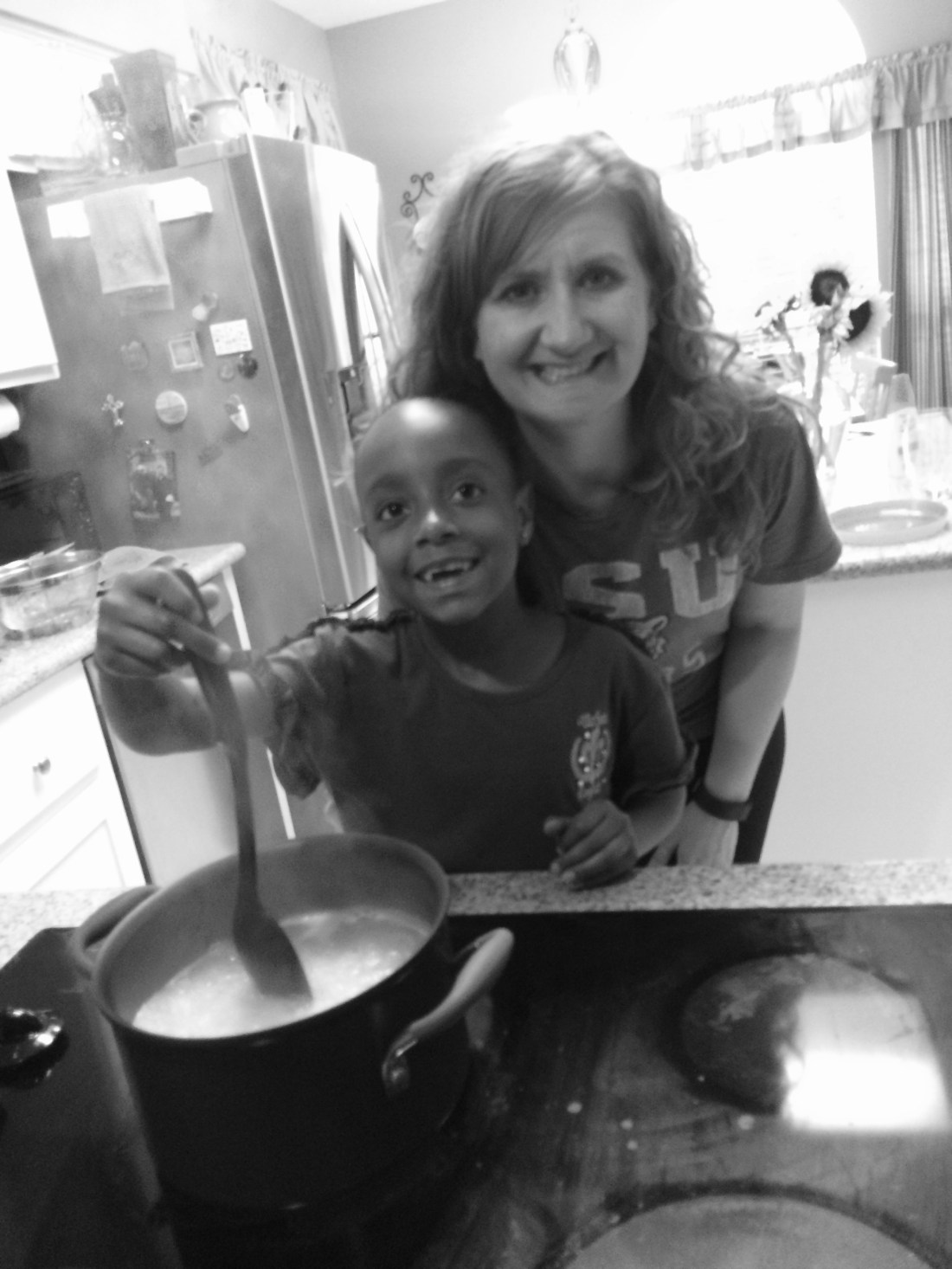
Of course, it is not all struggle. There are plenty of unique rewards and pleasures, as there are for parenting in general. One of our favorite pictures was taken on the very day I mentioned. Upon returning from the store, mom and our oldest got to work together on dinner. I took the opportunity to freeze the moment and have never regretted it. Written on her face is pure delight about where she is, what she is doing, and with whom.
She is, in the photo, at long last, home. These created, captured moments we cherish, where no paradox exists.