Library Stories: Astronauts

“Somebody donated these to the bookstore. I thought you might find a use for them.”

John Lottinville, one of several Friends of the Library board members and bookstore volunteers, reached across my office desk and handed me a set of old NASA prints of the Apollo 12 mission, released years ago and of no special value to anyone but a collector of early NASA memorabilia. John himself was a retired lawyer for the Johnson Space Center and retained a lingering esteem for the program, having met plenty of astronauts himself during his career, including those featured in the prints. I thanked him for the thought and took a closer look at his acquisition: over half a dozen cardstock prints each slightly larger than a legal-sized sheet of paper, featuring photos of various moments of the mission that followed the historic first landing.

Among the three crew members, which included mission commander Pete Conrad and command module pilot Dick Gordon, was lunar module pilot Al Bean — a wholly uninspiring name for a historical figure, in my humble opinion. He did, however, bear the distinction of having been the fourth man to set foot on the moon and was tied to Ted Freeman, whose memorial library I had, at the time, been managing for a few years.

“Ted Freeman“ isn’t a name many outside of NASA circles or fandom would recognize. Prior to 2004, I didn’t either. That was the year I began my professional career as a public librarian in Clear Lake, the southeast corner of Houston, in an updated facility named after an astronaut who, tragically, never had the chance to ride a rocket. It’s likely he would have been among those who would eventually find himself venturing into space or bouncing and gliding across the bright lunar surface, were it not for a bird strike that forced him to make the valiant yet fateful decision to avoid crashing his T-38 into residences below and veer off into open ground, undoubtedly saving lives in the process — save his own, that is.

Freeman and Bean joined NASA as a part of Astronaut Group 3, which included, among others, Buzz Aldrin and Michael Collins. As I studied the prints, I recalled this connection between the two of them. It then occurred to me that Bean was one of the few Apollo astronauts still living, and, as it just so happened, residing right here in the Bayou City.

Buzz Aldrin with Ted Freeman, October 30, 1964, one of the last photos ever taken of him. His T-38 accident occurred the following day.

I had found it fruitless in recent months to solicit a visit by an Apollo astronaut for the library’s 50th anniversary. Appearance fees for any of the most recognizable names are almost as lofty as the altitudes they reached during their missions, I learned, and public libraries are hardly blessed with the budgets of the many energy companies that envelop Houston. “Maybe I can’t persuade them to visit,” I thought, “but perhaps there’s another way to give the public at this library a closer connection to the program that began right here in their own neighborhood.”

I pivoted over to the computer, searched, and found that Bean, as many did, maintained a website, much of it featuring his art, a hobby he enthusiastically took up following his awe-inspiring trip to the moon. Clicking on the “contact” section, I punched in the details, noting Mr. Bean’s link to Freeman as a “classmate,” mentioning the acquired prints, and humbly requesting just a single autograph on only one of them so that they could be placed on permanent display for the public. My expectation after submitting the message was, in all honesty, to receive a response from an aide or site manager weeks later stating that Mr. Bean appreciates the request but would respectfully have to decline. I had read enough such polite refusals to expect nothing less.

Once and a while, however, persistence pays off. “Ask and ye shall receive.” A mere hour later, in my email inbox appeared a new message. Figuring it to be either an automated or stale, noncommittal response, I clicked, opened, and read the following casual reply as if the sender were texting a familiar friend:

Jim,

Can you send a picture of the prints?

Al

Now, few accomplishments top a trip to the moon. The first to attempt the journey were a uniquely capable breed of individuals who willingly risked their very lives to travel faster and farther than any humans in history. If any could be forgiven for possessing even a dim shade of an ego, they’d likely qualify. Yet, here I was, having been offered the special courtesy of a swift answer not by an assistant or secretary, but by the very astronaut who stepped out onto the lunar surface himself.

After taking a moment to register my shock that I was now engaged in an unexpectedly comfortable email conversation with a moonwalker, I gushingly replied with gratitude and haste, attaching pics of each and every print, offering to send them with a postage-paid return envelope. Within minutes, he again replied that he would be glad to accept my request and to send them his way to the provided address.

The following morning, I wasted no time and sent them on. I waited only a week for the large, prepaid envelope to return to me. Sitting at my desk, I carefully sliced open the narrow end expecting to find his autograph on the one print featuring his official NASA photograph with his crewmates. In this, I was not disappointed. But as I removed and laid out each of the remaining prints, I was delighted to find that Al had decided to do me one better.

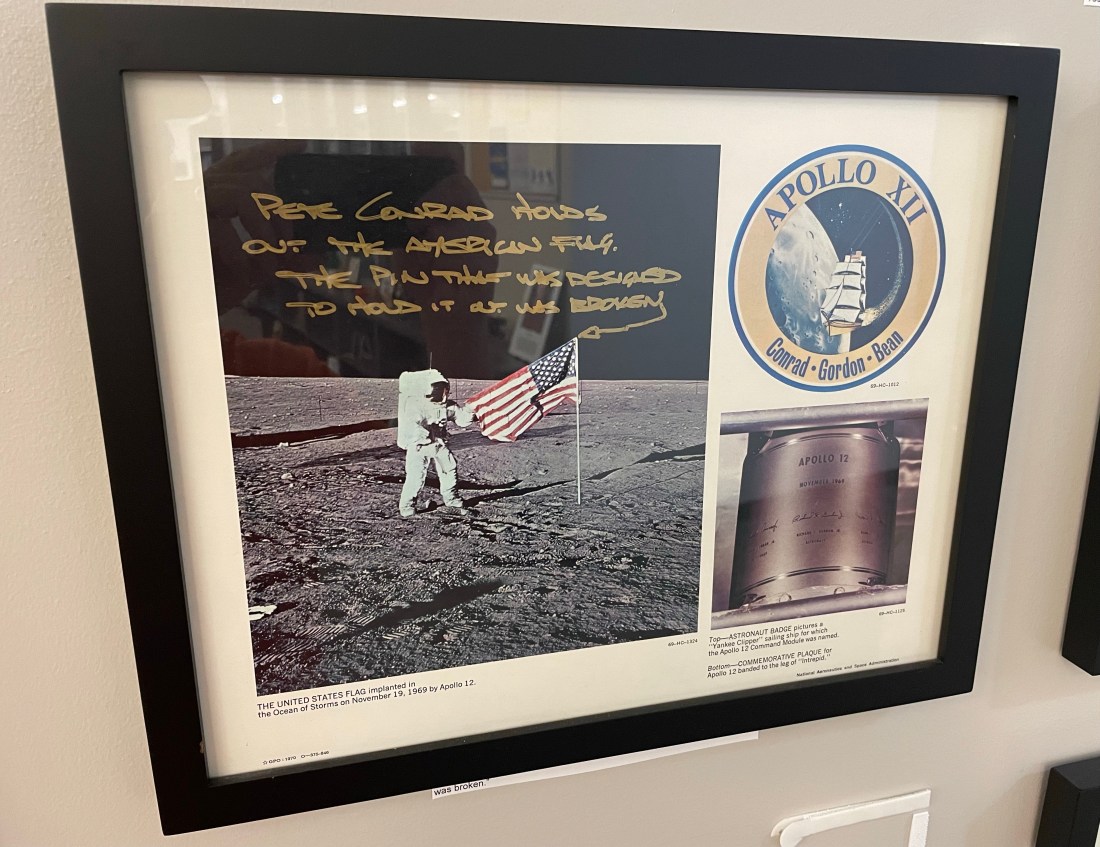
On each of the others, featuring a photograph of his and Conrad’s activity on the lunar surface, he detailed by his own hand and in as much space as the print would allow what he and his commander were doing in the image at that specific frozen moment in time. I marveled at what I was seeing. I took great pleasure in realizing what a staggering gift this was to this library and how it would further cement its significant, local connection to the space program. Bean had been beyond gracious to share these with his deceased colleague’s memorial building, and I couldn’t have been happier.

One of several autographed prints by Bean on display at the Freeman Library. This one, a photo he snapped himself, reads: “Pete Conrad holds out the American flag. The pin that was designed to hold it out was broken.”

Bean passed away a few short years after this gift to the library. Today, these signed prints remain on display on the second floor for the public to enjoy, right next to an American flag carried into space on Gemini V by his friend and Apollo 12 commander, Pete Conrad. I never had another encounter with an Apollo astronaut, but it remains one of my favorite stories during my time managing the Freeman Library.

Living and working in Clear Lake, you run into plenty of NASA professionals, all with their own unique jobs but all with the singular goal of sustaining man’s presence in space. I became a fan not long after becoming employed by the county library and learning all I could about the first full decade of the program in the 60s. The astronauts themselves, both past and present, walk among us here, and I’ve found few of them carry themselves as if celebrities. I once paid my rent to a former astronaut, attended church with another, and even had occasional interactions with one who received an embarrassing share of national publicity for an unfortunate personal mistake. It’s easy to forget those few among us tasked with such important, high-profile jobs that deserve the title of “missions” also shop for groceries, pay bills, and argue with their teenagers, just like the rest of us.

Next year, after over 50 years, four crewmates in many ways just like the rest of us will return to the same moon Al Bean walked upon, and I couldn’t be more thrilled. The first landing is one of the only events in all of recorded history that drew the attention of the entire world. It’s my hope that once again, for at least a moment, there will be peace on earth as all eyes are fixed on the moon above.

I’ve shared with several that I’d be happy to sweep the floors at JSC just to say I worked for NASA. I continue to be inspired by their efforts to explore, take risks, and challenge what’s possible. Alas, they’ve never called to offer a job, but I’ve nonetheless been grateful to have worked in the library that serves the NASA community. I’ll likely in years to come bore my grandchildren and great grandchildren with the story of my email conversation with the fourth man to set foot on the moon.

Past Time Pastime

50 yards deep. The salty sea of bodies were packed malodorously tight as sardines over a mile-and-a-half all along the edge of Smith Street downtown. All were there waiting eagerly to catch a fleeting glimpse of their 2022 World Series Champion Houston Astros as they passed in the victory parade. Little space, let alone breathable air, remained between one attendee and the next inside the dense mass. Attempts to venture into and navigate the crowd for a better vantage point proved just as toilsome as a ship breaking ice through frozen arctic waters. The slow but steady effort yielded nothing but an ever more challenging escape and no closer to the perfect view. Fortune favored not the latecomers to the party.

I had carried our daughters and a friend of theirs to the parade since the school, though scheduled as usual, allowed parents an excuse to take their kids to the event. The girls’ friend would later summarize the experience to her mother as “too much.” She wasn’t wrong. Along with the discomfort of standing almost two hours shoulder to shoulder with strangers were the occasional fainting child due to the stifling conditions and the ensuing panic of parents and bystanders shouting for a medic, or vigorously chanted expletives hurled by the same bystanders at a passing, generally unpopular politician near the beginning of the parade who also suffered the misfortune of not one but two unopened beer cans knuckleballed toward his head as if it were home plate. While I didn’t condone the act, I envied the containers for their swift, though violent, escape from the chaotic crowd, whose arms all were extended high with cellphones overhead, further obscuring any adequate view whatsoever.

“Can we go now?” my middle whined. While I sympathized with her discomfort, the players, who were bringing up the rear, had yet to pass, and for my part, I was willing to endure truckload after truckload of happy, featured participants not a soul recognized ultimately to elicit a cheer for our hometown heroes, if only for a moment. So, she would have to suffer just a bit longer. “You begged for this, kid,” I thought to myself, though acknowledging her pleas to attend had infinitely more to do with an excuse to miss school rather than an opportunity to express her (nonexistent) love of baseball.

The view.

At long last, the advancing roar of the distant crowds announced their approach. Spanning several trucks in the train were the players themselves, just as recognizable as they were on the television. The original and most beloved 2017 veterans were saved for the final vehicle, and as soon as we spotted the diminutive Altuve gleefully toting and hoisting the trophy from one end of his ride to the other, we snapped our pics, and I signaled the girls to move it out. We carved our way through the thinning press of people and trekked back to the van in the spacious, fresh air.

The experience left much to be desired, though I was pleased in the end to say we participated. The celebration was a fair distance from the moment my fandom began but not so terribly far in actual proximity. It was as a kid growing up in the nearby coastal refinery town of Texas City where I first learned to love and appreciate the color orange, its association with the revered and (now) reviled ‘Stros, and their home in what then was regarded as the “eighth wonder of the world.”

_________________

I couldn’t imagine why my mother was here. For that matter, where were everyone else’s mothers? We filed into the elementary school gym by class as 4th grade upperclassmen and found our places “indian-style” on the uncomfortable maplewood surface as mom, lined with other grown-ups and teachers along the wall, grinned and waved excitedly in my direction. I was as far from the status of “troublemaker” as a kid could be during my term in school, so it stood to reason neither I nor others were about to be the unfortunate subjects of a public shaming. Clearly, something was up with this seemingly happy interruption in our routine, and we all would soon find out what.

As everyone settled in, one of our esteemed teachers stood and began reminding us all of a writing assignment we were tasked to complete in recent weeks. I regretfully can no longer recall the chosen topic or a single word I penned for my submission, and I doubt I could then. As she continued, she announced the winners in ascending order, I could only guess, in order to sustain the suspense. Third place rose and was recognized, as was second. And now, for first place. Again, why in the heck was my mom here for this dull exercise?

I then discovered why. My name was announced as my mother’s ear-to-ear grin spread ever farther and those gathered applauded, all heads spinning in my direction. I’m sure I hesitated in disbelief, never having won first place for anything up to that point in my brief existence. Yet, here I was, being handed the coveted first-prize: three tickets to an Astros game in the Dome.

Baseball, until then, was familiar to me as a game that my father watched from time to time on television when his inconvenient chemical operator’s shift work schedule allowed it, or that friends and I played in our tiny front yard, which managed to serve only as an inadequate infield. Outfield was our neighbor’s equally minuscule front lawn, which ended our 17th avenue neighborhood before becoming the busy cross street of 21st. God help anyone’s vehicle who suffered a “home run” hit deep as they passed.

A small but visible divot in our concrete driveway functioned as home plate, the corner of the brick walkway to the front door as first base, a favorite climbing tree at the end of the lot as second, and a depression formerly the home of a palm tree stump as third. It’s difficult to say if the limited space favored either offense or defense, but many a game were played by my brother and I with all our friends up and down the avenue with my worn, blue Louisville Slugger and whatever ball happened to be available.

Few stories survive of these otherwise forgettable moments on our makeshift ballfield. A couple come to mind, however. Fancying myself a pitcher with a measure of potential, one of the many kids my mother kept after school at our home on behalf of working parents claimed to possess a share of talent as a catcher for his little league team. We each took our respective places as he squatted and I began my wind-up. As my arm gathered momentum and arced over my head, I released the ball, and I’m pleased to say it was right down the middle of the strike zone and should have been an easy grab for a seasoned catcher. Unfortunately, this first and only pitch was arrested not by a glove but by the front teeth of my counterpart, who immediately made a mad, screaming dash for the front door as if heading for first. Thus ended any aspirations I may have possessed to pitch one day in the majors.

Or there was the time my brother and I found ourselves without a ball one afternoon. Never fear, we were reminded. We did, in fact, have a ball, though in the form of a collector’s item on our shelf. One of us had received and displayed a baseball containing facsimiles of each of the Astros players’ signatures from the previous season. While it wouldn’t have drawn at the time anywhere close to a fortune at an auction, it was valued a little greater than an unsigned but useful ball acquired at the local sporting goods store. In other words, don’t use it for batting practice. I’ve often wondered what it might have fetched on today’s collector’s market had it lasted longer than our boneheaded idea to play with it. We’ll never know, however, for not more than a couple of hits in, as if the fates were out to punish us summarily for our disrespect, it landed directly in the street and rolled straight for the open sewer before we could prevent its disappearance.

The rules and technicalities of the game I learned piecemeal from my father when there was occasion to ask, usually while watching the team play on the television. These were the days Nolan Ryan graced Houston with his talent, racking up stats that would ultimately become unapproachable for all succeeding pitchers. I remember a unique event in only a single game I viewed with my dad, this one when Ryan himself was not on the mound but at the plate. While I had learned that few in his position ever made an impression in their batting average, we watched stunned as he knocked one clear out of the park that afternoon in what would be only one of two such hits in his entire career.

Ryan was also a rarity in that he was essentially a hometown boy, having grown up not more than an hour from the city. Few, if any, players these days have or take the opportunity to play for their own hometown, but Ryan headed to Houston once he had the chance following his stint with the Angels, in part so that he could be closer to home. While I’m sure the negotiated salary had something to do with it (he made headlines at the time as the first million-dollar player for the move), his local status made it all the easier for fans to cheer for one of its own.

_________________

Why do we love our teams? The players, after all, come from all corners of the country, and in many cases outside of it. Virtually none of them have actual allegiance whatsoever to your town or mine, at least not before they arrive, and are, in a sense, kind of modern-day mercenaries. They are experts in search of a job, and the organization with the deepest coffers tend to acquire the best talent. Michael Lewis’s book Moneyball and film of the same name fleshed this unfair reality out very well. Beneath the surface, it would seem the only loyalty possessed by the players who represent our town is to the mighty dollar. Little civic pride or honor in that.

I’m sure there was a time long past at their origins that the pinnacle of each sport was composed of those who “fought” for the community from which they hailed, though by amateurs. They didn’t quit their day jobs. Only local schools and colleges could now be characterized as such, however. We’ve lived long in the days of professionals in large, profitable organizations and franchises. It stands to reason and should be forgiven that few, if any, would be local. Any of us in our various professions have moved far from our homes the more specialized we’ve become. You go to wherever the work is. So, for those of us who are fans, we must cheer for a different reason.

_________________

My dad and I, for obvious reasons, would fill two of the three allotted seats won by the words I put to paper. The third I offered to my next door neighbor friend Eric, a grade ahead of me but nonetheless a frequent playmate outdoors. The cheap seats would plant us far above majority of the crowd, but no matter. In those days, the Astrodome was a sight to behold, and especially for an impressionable grade-schooler. While I don’t remember the outcome of the game itself, I’ve never forgotten the experience. The Dome is a Houston icon for many, including myself, and inseparably linked to the ‘Stros, due in no small part to that childhood visit. I was hooked as a lifelong fan, whether I knew it or not. I wouldn’t realize it until years later after I returned to Houston to begin my career and noticed on a trip to Academy a denim blue cleanup cap with the familiar “H” logo backed by the orange star. I hadn’t watched a game in years, but it was an otherwise empty object packed with sentimental value, so, naturally, I had to have it. It would become my favorite cap, in spite of their losing record at the time. Fortunately, unbeknownst to all of us, it wasn’t to last.

With the exception of the Rockets in the mid-90s, Houston fans have long learned to live with disappointment when it comes to hopes for a championship from its professional teams. The Oilers came and went. The Texans have sustained the losing tradition. So, you can imagine the doubt and reservations unspoken but nonetheless felt when “Sports Illustrated” produced their prescient cover predicting the Astros’s 2017 World Series win long before the season had begun. They had already miserably shattered our hopes with an embarrassing loss to the White Sox in the 2005 Series, the only one in which they had ever appeared, having been swept four straight games as if to suggest they never deserved to be there in the first place and perhaps weren’t a “real” MLB team to be taken seriously. This season would be followed by some of the worst in their history, at one point a final win-loss record laughably a mirror reflection of the best teams in the league.

And then, they started winning. Slowly but surely, season by season, they became consistent contenders, and it was fun once again to be a fan. Then came 2017.

The rest is, of course, history. At long last, Houston had achieved a series title, just as predicted. Yes, the news soon after would break concerning the cheating scandal, and elation would give way to frustration as the growing evidence could not be denied and scapegoats were named and dismissed. However, the following years remained winning seasons, and it would become clear that, love them or hate them, this team had genuine talent and could be on its way to a dynasty. The number of consecutive ALCS appearances alone since has demonstrated that the Astros are essentially the gatekeepers to the World Series in the American League. You’ve got to go through Houston first. And now, they’ve won a second, and cleanly, and again we’ve celebrated with pride, haters notwithstanding.

_________________

I had the opportunity this summer to take our youngest and one of his cousins to the first game of a double-header against the Yankees in Minute Maid. It was his first visit, and the lofty, distant view from the cheap seats mattered not to him. While his cousin, bored, inquired barely into the first inning how long this was expected to last, my son was captivated and likely would have gladly remained for the second game given the chance. They would win, much to our delight, augmented by the fact that it was the loved and hated Yankees.

The players’ origins, I realized after his first experience, mattered little to me or to him. It’s enough that they wear our colors and Houstonians all can find common ground and cheer together for them and for us. My son’s wonder and excitement formed a memory for both us, a memory he wouldn’t soon forget. And that was also enough.

One of my favorite gifts this Christmas season was a simple cleanup cap with the old Astros logo from their days in the Dome. It was small as gifts go but packed with nostalgia as tight and dense as the victory parade crowd. The image above the bill — the Dome backed by a field of orange — doesn’t immediately resurrect memories, but it does produce the happiness associated with them. It’s not always about the platform for the memories, as in this case, baseball, but about how the memories made us feel — feelings shared with others we love. And feelings die hard. Which is why, I would bet, win or lose, I’ll likely remain a ‘Stros fan till the day I die. I have nothing but that first childhood visit to the Dome with my dad to blame for that.