Unqualified

In less than a year’s time, my wife and I will celebrate 10 years of marriage. On our bedroom wall is a single, wide frame waiting to accept several small photographs of the two of us in five-year increments, arbitrarily up to year 25. My brother and sister preceded me in wedlock and remain happily married to their partners, each for 14 and 20 years, respectively. My parents are fast approaching their 48th anniversary, and I expect they will make it much further than that. Before “death do us part” ended their partnership, my paternal grandparents were wed for a slow and steady 60 years. My maternal grandparents, whom I have long lovingly referred to as “Meme and Papaw,” are still together and have been for a staggering 74 years.

I share none of this as a matter of pride. Rather, I say it to point out that the marital bonds made and rigorously maintained in my immediate family, along with the fact that I consequently have been spared the shock and heartache that formal separation can cause for all those involved, may explain, at least in part, why I feel such sensitivity upon learning of the divorce of friends, family, or even the most remote of acquaintances. It always breaks my heart. Each time I hear of it — and it happens more often now — the upset prompts me to take a closer look at my own marriage while wondering desperately how others’ could have ended, if for no other reason than to understand how to protect my own.

It’s an oft-repeated, banal statistic: half of all marriages in America end in divorce. I have heard more than once from the pulpit that this percentage “changest not” for Christian churchgoers, a fact perhaps surprising given that the faith is among the strongest advocates for the institution. There are plenty of risks in life I wouldn’t take given odds no better than those offered by the toss of a coin; but it would seem from the stats that’s the best deal any of us who venture into marriage will get. We enter into it confident and assured that love will see us through. But that’s not enough. From what I understand and have observed, what most commonly occurs for the unlucky in love is that time erodes mere romantic feelings, differences or offenses are left unresolved or unforgiven and consequently birth resentment, and resentment breeds contempt, until, left to fester, there is little left to salvage of the relationship.

Perhaps this is an oversimplification. Regardless, none of this happens in the space of an evening. Realizing the best or worst of anything in our lives is a patient process, and I have found in my 9 years that when I feel resentment creeping in, humility is the only cure. I am not a perfect man. If I follow the counsel of pride, I shouldn’t be surprised if loneliness accompanies my need to be right. So, I buy the bouquet and apologize.

I don’t intend that my thoughts alienate those who have known the pain of divorce, and I understand that the details surrounding such issues can be very complicated and may differ from one person to the next. We all need grace, myself included. But if you’re a believer, I haven’t come across any interpretive tools that allow one to sidestep the meaning of the simple, plainspoken words of God in the final book of the Old Testament: “I hate divorce.”

I have once felt the temptation to walk away. While it may not hold a candle to the experiences or challenges others have had, and though it wasn’t borne of resentment, it felt as real and compelling as anything else I’ve experienced.

Not terribly long after our oldest and youngest were placed in our home for the six-month long period before adoption could be pursued, we found ourselves one evening dealing with an irritable toddler who couldn’t get himself to sleep. We had endured the patient and exhausting process of training, paperwork, and preparation for two years and exchanged it for the draining realities of parenting in such moments as this. Most nights after placement were a challenge lulling him to sleep and keeping him in slumber, but this evening was different. As the night progressed, my wife and I found ourselves taking turns sitting up with him, occasionally drifting off only to wake soon again in a state of rapid and labored breathing and coughing. While he himself did not seem to be alarmed about his efforts, in hindsight, we should have had the sense to take him to the ER right then. We second-guessed ourselves, however, and tried not to overreact to whatever this was. By the time the sun began to rise, we could see nothing was improving, and so we made the decision to seek help. So, I got him and myself ready, and we headed to the hospital.

Arriving, we checked in, and we were not left to wait interminably after I shared the details and medical staff were able to see for themselves how he struggled to breathe. They soon found him a space and a bed and began the process of assessing him. Needles and such were soon to follow, much to his displeasure, as they found his oxygen levels much lower than normal. This would be the first of future medical visits that would ultimately acclimate him to medical treatment and form him into a better patient than he was at this moment.

Without the resources or expertise to treat him, it was decided that he should be transported to Texas Children’s Hospital downtown via ambulance. Once he was prepped, they rolled him into the back as I sat alongside him for the journey. After arriving, we would stay for four days and three long nights as they endeavored to stabilize him before officially diagnosing it as asthma and releasing him back into our care to head home.

So the routine business of day-to-day adoptive parenting began again, now with the added task of daily pharmaceutically-treated asthma prevention. We pressed on toward the goal of adoption, though I admit the adjustment from no kids to two kids had begun to feel extreme. I had more than one moment of anger or frustration at the changes and occasionally expressed this in such a way that surprised even me. I gained a greater appreciation for the fact that most of us are eased into parenting with a single baby; the needs are very basic, they don’t yet have much of a will of their own, and they are fragile in every way. Yes, the change is still a change, and one still loses some sleep and “me time,” but jump-starting from zero to multiple “not-babies” from traumatic backgrounds is not a natural life transition. The stress of such a change can compound if you don’t appreciate the adjustment required. And I didn’t fully appreciate how daily life would change.

A month later, the coughing began again late one afternoon, persistent and uninterrupted. Fearing another long night, we decided to forego the inevitable and brought him again to the local hospital. And once again, after evaluating him, they chose to carry him downtown via ambulance to TCH.

After he and I arrived into the evening, we were checked in and eventually placed in an ER room, where we were left to wait. My wife and our oldest soon joined us for what would end up a long night of patient observation. In the end, it was merely a cough, nothing more, and he was administered a steroid and breathing treatment. This would be one of our first moments in which a physician would inform us that his cough was not necessarily concerning; moreover, nothing but a steroid would be prescribed for it, due in part to the fact that physicians generally do not recommend cough medicines at his age — a frustrating reality for parents who simply want their child to sleep.

Early into the morning, exhausted, we were released from what felt like a waste of a visit, though assured our concerns were nothing serious. We made our way back to the van and headed home in the dark, the sun not long in rising. Though sleep was foremost on all of our minds, my wife and I knew relatively little time would be permitted for that. Our life now revolved around a couple of kids, and the toddler among them would be up very soon after the sun, prepared to wake the rest of us up with his needs and treat us as well you can expect of a sleep-deprived two-year-old.

This trip to the ER, not the first but the third for me with him (there was also, by the way, an unfortunate incident in which he stuck his finger into the moving, rolling track of the garage door as it opened) left me spent in every way. Our journey of parenthood had only just begun, and all of the training that sought to prepare us for moments such as this meant nothing to me now. Yes, of course, our life would change, it wouldn’t be easy, etc.; I’d heard all that. But here and now, I only felt complete and utter exhaustion. I also felt trapped with this feeling, realizing perhaps for the first time that I had made a commitment to this and all it entailed, that I couldn’t necessarily expect relief even when my head hit the pillow. I’d signed up for a marathon that would last not a few hours but many long years, and the pop of the starter pistol still echoed in the air. The entire course stretched endlessly before us.

As the weary morning began, I called a friend to take me to the local ER to pick up the car, where I’d left it before we were escorted downtown in the ambulance the previous evening. I then drove to the pharmacy for the prescription. Having collected it, I returned to the car, sat in the driver’s seat, and paused.

Staring aimlessly ahead, it occurred to me in my spent state — emotionally, physically, mentally, and even spiritually — that I wasn’t bound to this course. I still had a choice. I was alone in a vehicle that could take me almost anywhere I wanted to go. And what I wanted right now was to be anywhere but here, anywhere but home. I loved my wife very much, but I didn’t want the rest of it at this moment, not anymore. My new identity, the changes in how I spent my time, the challenges of parenting kids from trauma — it all was received and heard one way but experienced in an entirely different way. You don’t fully grasp what you’re entering until you step through the door.

A left turn out of the parking lot took me away from here. A right turn brought me home.

Turn left. Turn left and find an escape. Yes, you would leave your wife behind, but think how pleasant it would be simply to sleep and wake on your own time, not to be responsible for anyone but yourself, to let others more qualified than you take on the task of raising kids such as these. You’re clearly not cut out for this, so feel no guilt about walking away. Turn left. Doesn’t matter where, just go.

I don’t know how long I sat still and silent in the car. The weight of what I was actually considering slowed time to a laborious crawl. Everything in me wanted to abandon this choice I had made to be a father to kids I didn’t father, kids with whom I was barely acquainted, who looked nothing like me. I was tired, I was unqualified, and I wanted out.

At some point, I looked right. To return home, I had to find faith that I wouldn’t always feel this way, that things would be different, better, given time, that God was behind this endeavor. I wanted to believe it. But I didn’t feel it.

I picked up the phone and texted my wife. “We need to talk.”

Starting the car, I paused once more.

I turned right.

Our conversation would be one of the first and only times I’ve shed tears in front of my wife. While there would be other moments of tension due to the changes the adoptive process had wrought, in this one, I expressed how much harder this was than I expected and shared my doubts as to whether or not I could continue. In her own patient way, my wife listened, expressed understanding, and tried to counsel taking it a day at a time. If I learned one thing about her character through the process, it was that she was all-in, that she embraces challenges, even when the doubts creep in, and is more likely to look for solutions, any solutions, that would foster success. This should have been a strong indication to me that she was equally committed to us, to our marriage, if and when the road would be rough.

That was over five years ago. I hope I’m not so naive as to believe that had I turned left, our marriage would have instantly fallen apart. But it most certainly would have been the first step, possibly of many, in the wrong direction.

Parenting has the potential to be a strain on any marriage. Adoptive parenting, all the more. Little did we know at the time that in less than a year, we would take in their sister, who had the misfortune of enduring the instability of four primary caregivers before she ever arrived with us at the tender age of 7. She would also unwittingly provide us with a raw and jarring education on what it actually means to parent a child from trauma. The stress of it would test us many times, and sometimes it still does.

“It’s so great what you guys are doing,” we occasionally hear, referring to adoption. We don’t feel like heroes at all, simply because we know ourselves, and have a hard time responding to the compliment. It’s the humble confession that often follows, however, for which I have a ready response but choose to stifle. “I could never do that,” they say. “That’s interesting,” I imagine replying. “I feel that way almost everyday.”

Adoptive parenting doesn’t require perfection as a qualification, I’ve learned. I likewise shouldn’t expect it of other relationships, marriage included. If not for the grace of God, we would wait indefinitely to feel qualified to do anything of worth.

“If anything is worth doing, it is worth doing badly,” wrote G.K. Chesterton. While his words testified specifically in his time to a debate over amateurism versus professionalism, I take a little interpretive liberty and choose to hear it as a challenge simply to try, regardless of personal shortcomings or the potential for mistakes likely to be made. Some things in life merely ask us to press forward, qualified or not.
Just as with parenting, I’ve made my share of errors in my marriage. I can’t see the road ahead, but I fully hope and pray that my wife and I will eventually have a photo to insert in the 25 year spot of the picture frame, and then some. The faith I had that day that compelled me to return home felt far more minuscule than the storied mustard seed. If so, then there is something both true and effective in those words after all. Armed hereafter with nothing more than a sliver of faith, I need only believe, and keep turning right.

Paper Mirror

I have a problem with the phrase “the patience of Job.” I don’t know who coined it, but reading his self-titled account of misery (arguably the oldest book in the Bible, in spite of its placement), I can’t help thinking that whoever popularized it skipped ahead in the script and overlooked his bitter lines. When I read his story, which I have more than once, I’m left with the distinct impression that the only thing separating Job from your children or mine is that Job simply complains more eloquently about his lot in life.

I’m over-exaggerating, of course. The fact is, I don’t begrudge him his penchant for extensive bellyaching, in which I personally see little of the ascribed virtue of patience. There are few in Scripture who have more of a right to it than Job, in my humble opinion. After all, his suffering was not the result of personal sin, karma, or even chance; nobody to blame there except, maybe, yourself. No, his misfortune was the result of a bet staked between the Creator and the “Accuser.” While this book is among my favorites of the 66, it does feel a bit cold the way his life was essentially employed as a playing field to settle a score. Then again, as Job concluded, who am I to judge? “Surely I [speak] of things I [do] not understand.”

I imagine the virtue of patience is better applied to Job at the end of his ordeal, when he couldn’t possibly experience thereafter anything worse than what we read. Nowhere to go but up. And let’s be honest — it’s tales such as this that prompt us to think twice about asking God for more of this quality, which reminds me of another phrase: “Be careful what you wish for . . .”

Patience serves well those in my profession of public librarianship. Insert the word “public” before your chosen occupation and you’re likely to deal with anything and anyone, with special emphasis on the “anyone.” Moreover, the all-encompassing “public” includes you, me, and that difficult person you do your best to avoid. More often than we’d like, it’s the latter we librarians encounter across the reference desk, and without an extra measure of patience we’d probably finish most days with cuts and bruises, both given and taken.

During my time at the desk, I was given special regard among my colleagues for this quality when interacting with patrons or people in general. I even once was told by a staff person that they would settle when I showed up to handle a tense encounter; I brought calm to a situation, she said, though I seldom felt it. When once I paused to wonder why, it came as no surprise. I was bred, if you will, in relative peace and calm, thanks both to nature and nurture. I can’t recall a moment growing up when my siblings and I ever came to literal blows over anything, though we had our minor spats on occasion. I learned later as an adult, to my surprise, that such domestic tranquility is atypical. Nevertheless, my mother made it her mission to create an environment for us she rarely experienced in her own upbringing. Our consequent peace-loving natures unknowingly cultivated in us a conspicuous patience in our interactions with others, which, for the most part, has served us well in relationships. Patience, it seemed, was as natural to me as any functioning internal organ; whether I thought of it or not, it was somewhere in there and did its job regardless.

Enter children.

If you want to get to know yourself better, have kids. Contrary to popular belief, they don’t enter the world naked. They arrive equipped with a figurative outward-facing mirror designed to reveal to you and your spouse both your best and your worst characteristics.

Calib, our youngest, is still unaware that one of his purposes in life is to refine my patience, to demonstrate to me how little of it I actually possess. It turns out, I’m not quite the paragon of longsuffering that I once thought. He and his oldest sister, Deztinee, entered our lives just over five years ago and their sister, Dezira, a few months after that. As for him, it was clear from the start that this 2-year-old was not informed by the adoption agency that he had to accommodate my idea or manner of expressing patience, much to my consternation. It didn’t take long to discover that I myself had an inner toddler that felt the impulse to rebel when things weren’t going his way.

Our first family pics, only months after placement, were in Alexandria, Louisiana, home to my in-laws. One photo in particular of the two of us currently hangs on his bedroom wall. We were not able to cut his hair yet, per the rules, but we also hadn’t a clue what to do with it in the meantime. He consequently resembled a Don King mini-me, an expression on his face betraying an interest in stirring up mischief. I sit behind him, and it is, admittedly, a cute picture, except that my smile is forced, which only my wife would be able to identify. The photo is an honest picture of how I often felt and how he was bent.

Calib’s thorn-in-the-flesh, we would later learn, is an irritating little beast named ADHD. To be fair, almost every little boy has moments of inattention or overexcitement. I once was among those who discredited the disorder as an excuse for poor parenting or the result of too much screen time. While I wouldn’t dismiss that possibility out of hand, my wife and I could see we were doing the best we could, yet he struggled to focus and get it together, especially in school.

There are an overabundance of distractions in our day-to-day life, notably digital. With ADHD, however, the tendency toward distraction can be triggered by anything; digital devices, interestingly, often provide an opportunity to focus. External distractions, however, abound. A two-minute task such as getting dressed in the morning, unsupervised, may take twenty minutes, or may never happen at all without oversight, since the die cast superhero figures need to be setup in a row on the bed frame, and, hey, is that a dog outside? I love dogs. Where is my dog book? I don’t see it, but this other one has stickers in the back and etc., etc., until mom or dad return to find that, while many steps have been taken over the last half-hour, not one of them was in the right direction. Make this a daily occurrence for multiple tasks and you’ll have some idea of the struggle.

That’s the AD side of the coin. The HD, in Calib, manifests itself, at its peak, as a surplus of supercharged joie de vivre, as in, life is a musical comedy, he’s the leading man, and dad is proving a tough crowd; no matter, I’ll just sing louder and see if I can break him. He can put on an entertaining show, but it makes for a long day. I once attempted, at bedtime, to almost hypnotize him into standing still and quiet. While he made a valiant attempt, the resemblance to an animated rocket shaking under the pressure either to launch or explode was jarring.

Put the two of these together, AD and HD, and it’s difficult for the afflicted to get anything done. It became clear after some time that he, and we, needed help. If he wasn’t focusing in school, he was using the environment as his stand-up stage, his classmates a captive club audience. Such a bright shade of positive energy may not sound like the worst one could imagine, but he simply wasn’t capable of reining it in. After a diagnosis by both a psychologist and physician, it was determined he was a candidate for medication. Once the dosage was pinpointed, the change was almost immediate with no negative side effects. Straight As and no more notes or calls from the teacher.

I don’t necessarily consider it a miracle and wouldn’t stand in front of a camera to laud the benefits of medication, but it proved an enormous help for the time he has to spend in a classroom. You can’t and shouldn’t medicate 24/7, however, at least not in our case. For the moments in between, which is typically with us at home, my patience is still significantly tested. As with his condition, it remains at times hard for me to rein in my impatience.

For those who attempt it, getting kids ready for church on Sunday mornings is its own special challenge. Success or failure hinges on getting everyone out the door and into the van at a reasonable time with lofty aspirations of arriving no more than fashionably late. It’s tough, but it can be done. First things first, though. At breakfast recently, I responded to his antics with severity rather than understanding and lost my cool with him more than once, much to my wife’s, and his, displeasure. As justified as I felt at the moment, and though there was resolution, albeit imperfect, self-talk, as it’s known, judged me a terrible father. It often does.

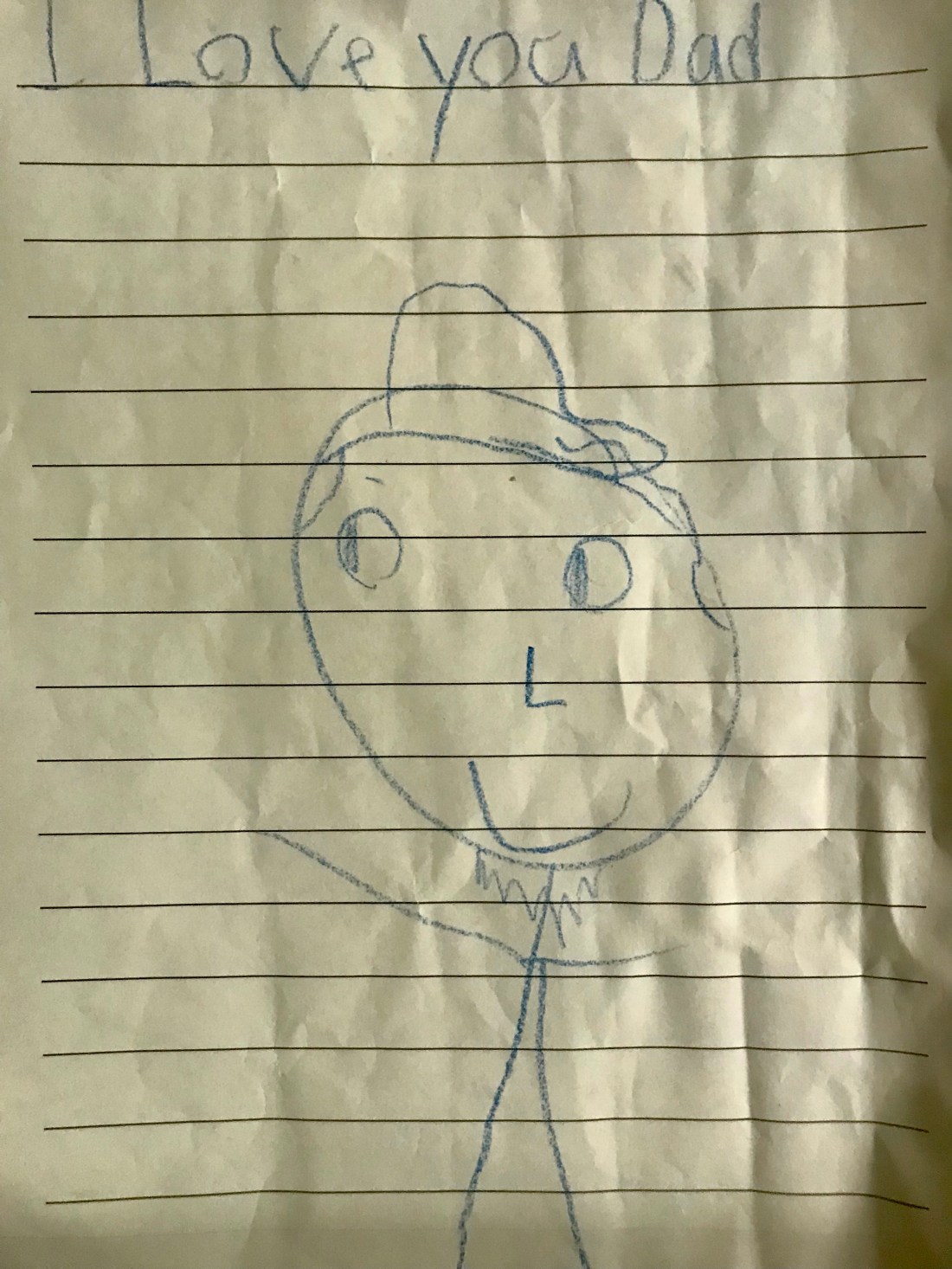
By the time service was finished, he stepped into the van and passed forward to me from the back his most recent masterpiece. On it were the words “I love you Dad” and his best impression of me, complete with baseball cap and facial hair, not to mention a smile on my face. Jenny, my wife, also received a similar image from his time at camp a week before. Though it was intended as an opportunity to write a letter to mom and dad, he took the artistic route and penned a simple picture of her surrounded by hearts. In any event, his portrait of me didn’t reflect in the slightest what I saw of myself that morning, but it was a revelation to me that the mirror our kids unwittingly hold up to us seldom reveals how they actually see us.

Beneath the ADHD that frustrates and tries my patience almost daily is simply a kid who loves his mom, wants to please his dad, and who would rather spend his camp money on gifts for each of us than on himself. To that, I say thank God for the patience and forgiveness of our children. Without it, we would not see ourselves as they do and might not have the courage as parents to get back up and try again.