“Be joyful in hope, patient in affliction, faithful in prayer.” – Romans 12:12
He rose feebly from his elevating recliner and shuffled deliberately out the back door with the help of his walker, in spite of my insistence that my daughter and I could handle it. You don’t argue with your 91-year-old grandfather, however, especially one as headstrong as mine. While visiting my parents for a few days in the DFW area one summer, my oldest and I found a moment one afternoon to drive to my grandparents’ house and retrieve a lawnmower they no longer could use due, of course, to their age, and she and I were happy to load it ourselves into the van to transport it to my parents’ place a brief 5-minutes away; if not, that is, for his resolve first to teach me a thing or two.
As if my years of practical experience with this simple machine counted for naught, he scooted hastily out the back door and into the driveway, released his grip on the walker, grabbed the handlebar of the mower with his left hand, and with awkward elderly aggression repeatedly yanked the pullstring with his right in order to demonstrate for my benefit how to start the motor. I gave up on my insistence and resigned myself to the likelihood that my teenage daughter was about to suffer the indelible trauma of Papaw cranking a lawnmower and collapsing violently and fatally to the pavement from overexertion. To my surprise, it started, he survived, and I thanked him for the unnecessary lesson as he shuffled back inside.
I have little desire to live to 100, as many do. Maybe I’ll sing a different tune the closer it approaches, but from my vantage point on the timeline, old age is no picnic. We all think we want a long life, but what I suspect is what we actually want is to put off the reaper for as long as possible. Though we all have our beliefs about it, death is largely an unknown, and the unknown is a source of fear for us all, especially those of us with little faith. The Bard put it best: “But that the dread of something after death, the undiscovere’d country, from whose bourn no traveller returns, puzzles the will, and makes us rather bear those ills we have than fly to others that we know not of?”
In any event, my grandparents, now 93, find scant strength or energy to do much more than gingerly transition from one seat to another inside their modest home, and this very seldom. Trips outside of the house are rare, and for good reason. The world is built for a pace that often exhausts even me; how much more so for them, exceeding the capabilities of both their minds and bodies.
It would seem an accomplishment to have reached their age. The only fact as impressive might be the number of years they have been together: 75. Their marriage has nearly outlived the CDC’s researched average life expectancy of most Americans, which they plot at 78 years, give or take. A few months ago, they celebrated this milestone in their own quiet and understated way, satisfied with a fried chicken dinner with my parents, my wife and I, and our youngest. No gifts were requested or exchanged. There is nothing on God’s green earth nor among man’s manufactured creations they either want or need any longer other than a good meal and the company of family. They have both given and taken much of what one is able to of life and have exhausted their interest in the common wants and pursuits of younger men and women who have many years stretched ahead of them.
Our visit in celebration of their anniversary concluded on Saturday, and we left the following Sunday morning. My wife and I and our son began the 4-hour trek back to Houston, departing bright and early in order to pick up our daughters, who had spent the weekend at a church youth retreat. Timing ourselves to arrive at noon, we grabbed on the way out of town our son’s favorite sugar-saturated breakfast — donuts and chocolate milk — and were on our way.
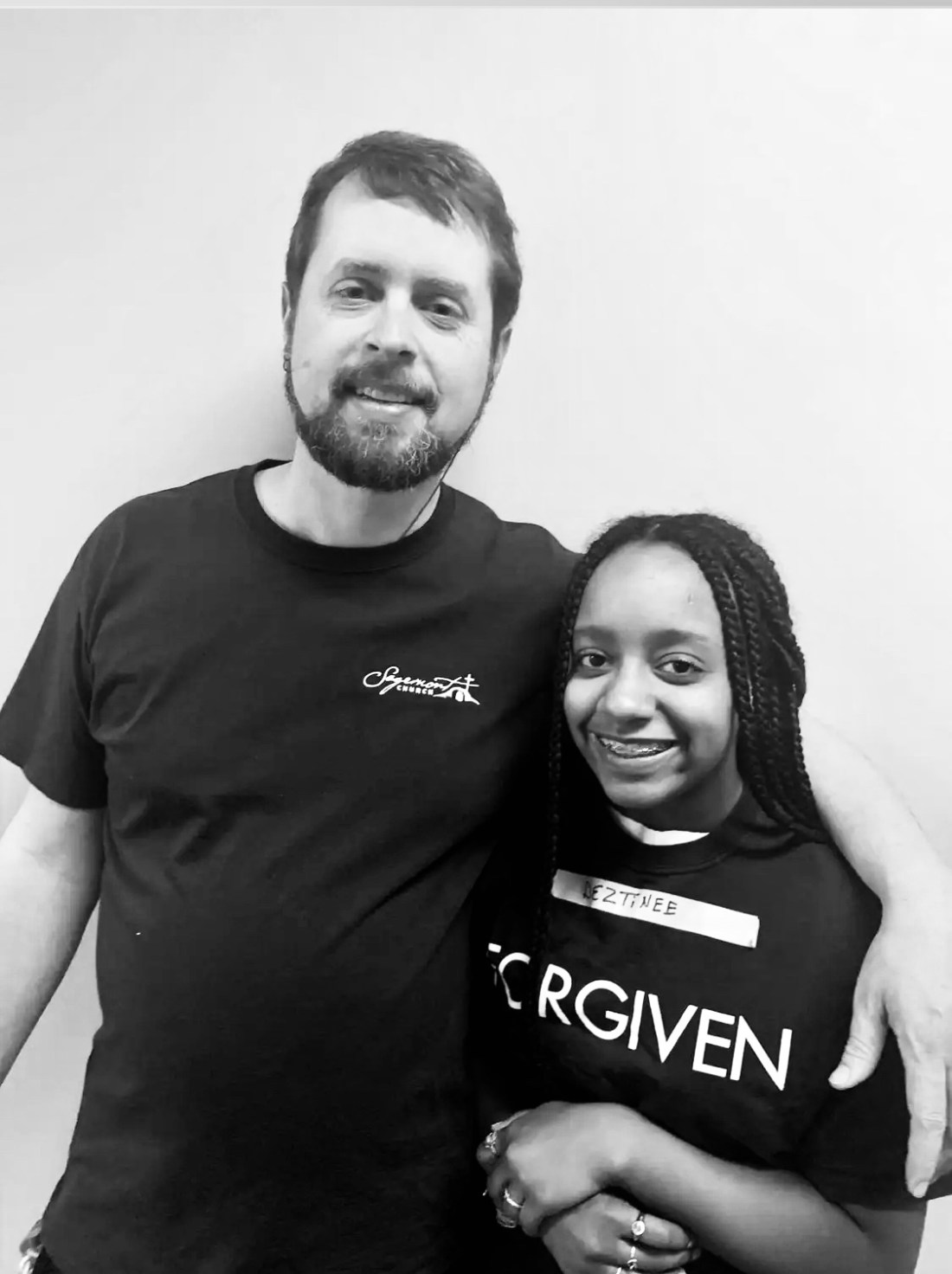
Scarcely an hour into the drive, my wife’s phone rang. She answered familiarly, though I could only guess at who was on the other end. The comfortable greeting segued jarringly into an expressively ambiguous “What?!” as I wondered at both who might have died and who was thoughtful enough to share the tragic news. Instead, she turned to me and exclaimed with unabashed delight that our oldest was calling from church to tell us she was getting baptized that morning during the service. She had made a “confession of faith in Christ,” as we Baptists like to call it, and was performing her first act of obedience as a new Christian.
We all bear hopes for our children as they mature, some of them very specific and unique. For parents such as my wife and I, our Christian faith is an inseparable aspect of our identity, in no small part due to our parents’ influence, both of whom were ministers. The decision our oldest made that weekend remained at the top of our list of hopes for her and her siblings from day one, even more so as adoptive parents, considering we often feel as if we’re making up for lost time in their early upbringing. The relief, satisfaction, and joy of learning that they have independently embraced your faith, making it their own, cannot be understated. There are few decisions they will make in life that will have a greater impact on how they will choose both to see the world and to act upon it, a world that increasingly pushes faith to the margins or dismisses it altogether.
As ecstatic as we were to hear the news, we pled with her to wait until the following Sunday when we could attend along with her grandparents. Moreover, I asked her for the privilege of baptizing her myself, still technically a licensed minister, though I did not pursue it as a career as I once had planned. She gladly agreed, and we ended the call. Though the decision was her own, my wife and I in silence and welling tears took each other’s hand, a knowing gesture expressing a sense and gratitude that we are, after all, having an impact upon them.

Though the role of parenting never truly ends, Paul’s exhortation to his Roman readers centuries ago — “Be joyful in hope, patient in affliction, faithful in prayer” —seemed fitting for where we found ourselves up to the moment she shared the news. It’s an ideal verse for parenting in general, as it is for the life of faith. And as much as I could retrieve my college toolbox of rusty hermeneutical implements to plumb its meaning, I find ample clarity on the surface to see through to its depths.
“Be joyful in hope”
“Are you okay?”
I heard this question from my wife more times than I can count during the first year of our marriage. The fact is, I hail from a family whose emotions are generally subdued. We’d make great poker players, if only for our lack of facial ticks or cues (though I am told I have made a recent habit of talking to myself). Wearing one’s heart on one’s sleeve, as the expression goes, is just as risky emotionally as it is physiologically for my ilk. Not so with her kin. As couples do, we learned a few things about one another once we were under the same roof, one of many about how we do/don’t express our feelings. My answer to her question was typically that I was fine, which was true, but after a month or so of this, it left me with the impression that one of the implications of our marital vows was that I turn cartwheels across the living room if I were even moderately pleased in the moment.
While I am generally “fine,” it might surprise those with whom I’m acquainted that if there is a yin and yang in every relationship, it is I who bears the honorific of “sourpuss.” I lean towards the negative end of the spectrum in our partnership, though, perhaps, not to the extreme. With only moderate influence, my confidence may be sapped and feelings tipped easily to the pavement by the difficulty of the moment, especially when it regards the frequent ups and downs in the lives of one’s children. My wife, by contrast, is characteristically optimistic and positive about life and all that it presents. It is one of her many attractive qualities as well as a reason, I would argue, I often hear another loaded string of words from her that instantly elevates my anxiety: “I have an idea.” Such ideas as hers, furthermore, tend not to be small in stature and carry the expectation that I find a way happily to get on board. They are big and bold, and this, I believe, because she is “joyful in hope,” as Paul wrote. She generally expects the best of wherever she focuses her efforts, and even if such expectations are dashed, she merely picks herself up and moves on to the next idea.
While we both agreed to it and believe (on most days) we were called to it, parenting by way of adoption was one of these big ideas. If I had thought the 1-2 years of training was hard, I was in for a shock once the kids were placed. “They have no idea what they’re getting into,” my mother expressed to my siblings, each already in the thick of parenting for several years. Prior to parenting, the endpoint of my various “hopes” often landed at the end of the week, month, or year; in other words, at a distant point in the future. The phrase, “take it a day at a time,” however, took on startlingly new meaning with kids. The object of my hopes shrunk temporally — Let’s see if we can make it to bedtime without incident. Currently, we are finding ourselves in the thick of the teen and preteen years.
I will admit, though, that I have felt little joy in hope, as Paul encourages, even in the smaller day-to-day portions. The fact that he does encourage it, however, indicates that we have a choice. How hard a choice it is to make. We hope especially for big change and progress in our kids, but it is often slow in coming, if or when it does.
When I lowered and raised our oldest in the cold water that morning at church, I felt a hope fulfilled. It was easy to find joy in that moment, and, not to mention, to wish that I had chosen to be joyful in my hope until then. My mother was recently asked what advice she would offer her younger self given the opportunity. “Don’t worry so much.” Likewise with hope and the attitude we choose towards it. As much a high it was in that moment with her in the baptistry, there would be a down just around the corner, to be certain. Such is life with children.
“Be joyful in hope,” Paul says. Choose joy as you wait, as he segues into the manner in which we should do so under unfavorable circumstances.
“[be] patient in affliction”
He coasted into the oncoming lane, thinking the maneuver would allow him to avoid the car that had drifted into his just ahead. The other driver drifted back, however, and then once more as each responded in kind. They collided at the last second, too late to correct.
The police report took longer to read than the event itself, which was a theory, at best, since no witnesses were present. The drifting driver was drunk, and he would languish in the hospital for another week, his life ending ironically on the day my grandparents and mother were to celebrate when my uncle’s began. His life, however, ended instantly that night on the road.
I would never have the privilege of knowing my mother’s brother, who exists for me only in various stories and a few photographs. I’ve thought it odd that he should survive the many deadly perils of the Vietnam war as a marine only to meet his end at the hands of a careless driver once home, and this not long after his return. The best years of his life should have been yet to come, but it was not to be.
My mother had anticipated upon his return a relationship as adults better than that they had shared as children, which was often strained. My grandparents had to endure the tragedy of burying their child, a fate no parent would wish upon themselves or others. For each of them, the grief of the loss became what felt much like a physical affliction, lingering and painful, deep into the marrow. There would be no closure.
The “affliction” my grandparents were forced to endure patiently following his death was not for a hope that he would return to life but the absence of an answer to the overwhelming sorrow they would feel in their remaining days, months, and years. They would live in the unexpected reality of an unshared life with their only son. How does one ever overcome such an affliction?
I can’t imagine how one could ever arrive at peace after such a devastating loss. What good is patience if my child will never return in this life? One either wallows in bitterness, or allows the years and one’s faith to reward patience instead with one’s grief. I am happy to say they opted for the latter, finding other joys in life while preserving in gratitude the memory of their son.
I still have my children, and, hence, hope for my patience with the “afflictions,” if you will, that they bring home. If my grandparents were able to move past a grief that threatened to drown them, surely I can find the patience to deal with the day-to-day.
“[be] faithful in prayer.”
My grandparents’ home was modest by today’s standards, but it sufficed, and it was a safe and comfortable place we enjoyed visiting during our childhood. We learned to love and cherish what we saw and experienced there. The backyard garden full of vegetables, my grandfather’s workshop walls lined with all manner of tools, a batch of homemade chocolate chip cookies cooling on a sheet of wax paper in the kitchen — all became welcome and familiar sights as the years wore on. But it wasn’t only the daylight hours in their home that left an impression on me.
Rising in the middle of the night, a step or two was all it took to traverse from the guest bedroom for a quick trip to the bathroom. At the end of the short hallway was another bedroom, though used as such only when all three of us siblings were visiting. Without fail, if the time was right, I would catch a glimpse of our grandmother crouched on the floor, Bible spread in front of her, studying and praying. This, we learned, was her private routine each and every night. Well after midnight and into the earliest hours, she would rise from bed and take advantage of the stillness and silence to study and to pray for all those she cherished. I never learned how long she spent up in this posture before returning to bed, but what was certain is that she was faithful in this practice for all the times I spent in their home.
I wonder if this verse ever crossed my grandmother’s mind in the midst of her despair at losing her only son, a pain — an affliction — that would never fully be alleviated. There is no pill to swallow that would restore the loss. One learns to live with it and, in their case, lean on the words, even if it is a circumstance for which there will be no change. How one could chose to remain faithful in prayer rather than bitterness is beyond me, but she did, habitually rising for an intermission in slumber to pray.
I also wonder that the reason God has allowed her to live as long as she has is because he knows me and mine still require the faithful prayers of spiritual stalwarts such as her. God knows I allow myself far too many distractions to practice this discipline as well as her. Then again, it’s difficult to find many nowadays who do. I’m thankful, nonetheless, that I have one in my bloodline who has never failed to continue praying for me. I can only hope to live up to the example she has set.
Yes, hope. Seated behind each of these admonitions from Paul is, I believe hope. Without it, I have no motivation to be joyful, no cause to be patient with my troubles, no reason to pray faithfully. Hope is a foundational Christian virtue, and I find I need more than a heavy dose of it, especially with the bad news and negativity circling us daily in the world out there.
But it’s often more a choice rather than a feeling, especially for those of us not engaged in the conscious practice of choosing it. The more any attitude is chosen, the more readily it becomes our nature.
My grandmother had no hope of ever seeing her son again in this life after that fateful night. There was seemingly nothing left in which to hope for him and every reason to cease caring about a cruel and unfair world in which all your hopes, in her case for her child, evaporate in an instant. And yet, she somehow managed to continue to try and live out this verse day after day in the first and earliest hours of each and every day.
That, I realize, was because she learned not to center her hope in her child and his future but in the one to whom she was offering her prayer.
I admit to despairing from time to time over my inability to maintain good personal habits, in the behaviors my kids may or may not exhibit, or in the pitiful state of the world at large. But it occurs to me, considering my grandmother, that the reason may lie in the fact that my faith, my hope, may be misplaced. No wonder I remain disappointed.
My grandmother has never instructed me to rise in the middle of the night to pray. This has been her discipline, not mine. But, unbeknownst to her, I’ve observed it enough to admire it gratefully, not just in the knowledge that I have been and remain one of the subjects of her prayers, but in the example of unwavering hope such a secret practice she has unwittingly left as a legacy to me. It is joyful hope that prompts her to rise, patiently and selflessly sacrificing time that could be spent in sleep, faithfully offering her prayers. I’m not sure to this day she knew I was watching, but I was.
Would that I would learn to demonstrate hope through such steadfast discipline, and that my children, perhaps my grandchildren, would be left an example of hope that would likewise sustain them in the lives they have yet to lead.