First Leg

At 15 years of age, the farthest west I had ever traveled was Colorado for a family trip to Estes Park, where I remember trail riding on horses (always a go-to activity on family vacations my mother planned) and taking in the beautiful elevated natural sights. The farthest east was Florida for one of three trips to Disneyworld, two with family and one as a high school sophomore for a band competition and performance at Epcot Center. Anything beyond these boundaries I was forced to explore in one of the sundry, yellow-spined issues of National Geographic filling out my father’s bookshelves in our living room. During my freshman year, I sat through World Geography, memorizing each and every country’s capital and discovering customs, cuisines, and landmarks around the globe, all detailed vividly in textbooks or in full, moving color on a television screen. These places existed where I had never been and might as well had been the stuff of fiction, since I was just as likely to visit the other side of the earth as I was to “explore strange, new worlds” in a starship.

On the cusp of my 16th birthday, however, that was all about to change. Here, at the edge of my 46th as I pound this out, I recently reminded my family that it had been 30 years this month since my parents took a leap of faith and brought us all across the ocean into what had been a formerly communist country only a few short months before. In the course of our text exchange, mom asked what we remembered about our exit, the first for any of us outside of the U.S., not for a mere visit but to change our residence. We each teased out snippets here and there, but a text conversation is rarely adequate for detailing personal events that deserve greater space. So, I felt compelled to take the time to stretch my own recollection of our initial departure further. What follows are my own sequenced but scattered memories of those first few days of travel.

For the sake of context, it might help to recall the world as it was in early 1992. The internet had not yet moved in to the majority of U.S. homes, and smartphones still might as well have been the stuff of science fiction. No one carried a mini-computer, much less a phone, in their pockets or purses. The average price of gas was in the neighborhood of $1.13/gallon. Johnny Carson hosted his last episode of The Tonight Show, and 60 Minutes was among the most popular programs on television. Police officers accused of beating Rodney King were acquitted, sparking riots thereafter in L.A., and Bush and Yeltsin declared a formal end to the Cold War, the Soviet Union having disbanded the year previous.

This was the general state of things as we rolled up for the first time to Houston’s Intercontinental Airport in June of 1992. It wouldn’t be renamed for the standing president for another 5 years. Dad was already making his way to Ukraine by land in Europe, having traveled with mom there the month before. She had returned after a brief visit to retrieve my brother, sister, and me. We had been staying with our maternal grandparents, who were experiencing one of the most difficult separations of their lives with our departure. We were their only grandchildren, and our mother was their only surviving child. Moving indefinitely to a country that until only recently was a Cold War enemy and taking the grandkids as well was breaking their hearts. Communication would be neither routine nor convenient; letters delayed by international postal services would have to suffice the majority of the time. We didn’t know when, or if, we would return.

As we waited to board, friends and family lingered with us at our gate in the terminal, taking for granted what post-9/11, still a blissful nine years distant, would strip away when airport and traveler security would become a priority, excluding all but passengers. Tears are what I remember as we stood by waiting for the announcement. Tears, hugs, and a deep sadness, some among us still wondering why my parents had picked this path, though they would say it was picked for them, and why they were taking us with them. The world was much bigger then, made so by the inability to connect instantly with one another in a variety of ways, as it is today due to the ubiquity and convenience of technology. When connection is scarce and limited, distances between those we love, especially physical distances, feel impossibly far away, as we would find.

The time had come, and we began the process of boarding, saying our final goodbyes and producing our tickets at the gate for the long flight to Germany, our first stop. I remember little of the flight itself, but a few details stick out. First, it was long. Up to that point in my young life, a puddle jumper to the Panhandle summed up the bulk of my flight experience as a passenger. The duration was just long enough to recognize that taking off and landing were the most exciting sections of the trip. Internationally, however, these maneuvers were a mere fraction of airtime, and, by the way, kids (and, come to think of it, adults), there were no iPads or screens to occupy us. So put that in your pipe and smoke it. Speaking of, and second, smoking, though recognized even then as an unhealthy habit, still had a foothold in most public places, including flights, though with some limitations. You’re all breathing the same encapsulated air, however, so you’re bound to take it in. My brother recalls receiving more than his unwanted share of it where he found himself seated. In any event, it’s a wonder there were not the irate passenger incidents we hear so frequently about today in the news. Easy to make a case of how spoiled and entitled we are; we put up with so much more then.

At long last, we landed in Frankfurt, still a hub for European air travel, and, to this day now as a more experienced traveler, one of my least favorite stops/layovers for its confusing sprawl. Exhausted but soldiering on, we waited with our group for the following flight that would take us in to Moscow for a day or two before our final destination — Lugansk, in far eastern Ukraine. We were traveling with a party of church-goers who were on mission not simply to escort us in but conduct a couple of weeks of mission work and evangelizing. I complained to my mother of my stomach — a tell-tale sign of anxiety I would become well-acquainted with at that age. My mother, with as much empathy as she could muster in her fatigue both emotional and physical, dismissed my pains to nerves, duly so, though it was little comfort.

In due time, we boarded the next flight bound for Moscow. Strangely, I remember absolutely nothing about this leg of the journey. Maybe I slept, maybe I didn’t. I assume my brain was too worn out to make a meager effort to file away what must have been an inconsequential experience. At any rate, we landed, we exited, and whatever was lacking in the previous few unremarkable hours of travel would be compensated for with impressions that planted their roots deep and have never escaped my memory.

It’s difficult to describe what it’s like stepping the very first time out of the familiarity of your own country and into another so unlike your own, one you have seen only on a screen or in pictures. Both fear and anticipation mingle together as you move along, sharing in common only your experience as a human being. All the rest has to be felt and experienced; you’re a kid once more, learning about the world, or at least a different part of it, and everything old is new again, so to speak.

Stepping out of the plane, I followed our group down the stretch until we each were expected to pause at a customs booth. My turn arrived, and I stepped before it, my eyes meeting those of a young uniformed Russian soldier, complete with the storied hammer and sickle pinned to the front of his military-issue hat atop his stern, no-nonsense head. His expression betrayed nothing except discipline and an expectation not to be trifled with. I produced my passport in silence as he took it, studied it, looked up, and studied me. Here, now, was my genuinely first experience of someone foreign in a foreign land. I felt a mixture of dread and excitement as his gaze lingered. This soldier, who resembled an authentic version of the enemy we had been educated to believe in, stood before me now in judgment. My fate was literally in his hands as I waited, alone, one solitary thought passing my mind: “This may be the coolest thing that’s ever happened to me.”

I’m certain I detected a subtle smirk as he returned my passport and sent me on my way, satisfied he had produced the desired and intended psychological effect. As we moved on, after collecting our luggage, we waited inside the airport for transportation to the hotel. As other travelers passed us by, none of them American, I caught not only glimpses of my fellow foreign man but also his/her odors, I’m sorry to say. This sense impression is, of course, nontransferable in a picture, moving or still, and can only be experienced in person. Near us were, I recall, a couple, disheveled but clearly traveling. Accompanying them along with their luggage was a smell I had never encountered, but was unmistakably body odor on a level I can only describe euphemistically as “otherworldly.” It was there I’m sure I learned to hold my nose without actually holding it, closing off my nasal passages indiscreetly so as not to appear rude.

On the heels of this was my first encounter with an alcoholic, ranting and gesturing incoherently, I can only guess, though I could not understand the language as of yet. At some point in his tirade, he stumbled in our direction as one of our interpreters intervened and headed him off, redirecting him elsewhere. This disease, we would learn, was, and, for all I know, may still be an epidemic problem in Russia. More than once over the course of the following year we would encounter such persons, one of them I distinctly recall belly-up in the mid-day sun adjacent to railroad tracks as we were on our way on foot into town. We had to pause a moment to be sure we were not witnessing instead a fresh corpse. Fortunately, we observed his chest rising and falling ever so slightly as to indicate signs of life, and so we chose to move on, finding him absent from his improvised grassy bed as we passed by upon our return that way.

Our pastor had joined us for this trip, and I was paired with him in one of our two-person rooms at the hotel. Waking the next morning for a little sightseeing with the group, I discovered I needed only to roll over in bed to observe the first of many new sights that day. There he was, seated at the edge of his bed, Bible in hand, marveling and remarking to me about a passage in Scripture, clothed merely in an undershirt and “whitey-tighties.” Nothing inappropriate took place, mind you, but needless to say, I was not feeling as inspired by the lofty passage as he, and I never again saw him quite the same way when stepping into the pulpit.

Red Square was my first taste of a famed, truly foreign location, and it didn’t disappoint. I’m sure I was a sight to behold as well dressed as I was, sticking out like a sore-thumb in threads one would acquire solely in the U.S. Prior to leaving the States, I had earned my high school letter as a sophomore via band, so I was afforded a letterman’s jacket, which I wore proudly on the trip. I foolishly accessorized this with a Confederate Army soldier’s cap, which I purchased in Frontierland at Disneyworld before they, and I, “woke” to the inappropriateness of such a souvenir and what it represented to many, thereby discontinuing it.

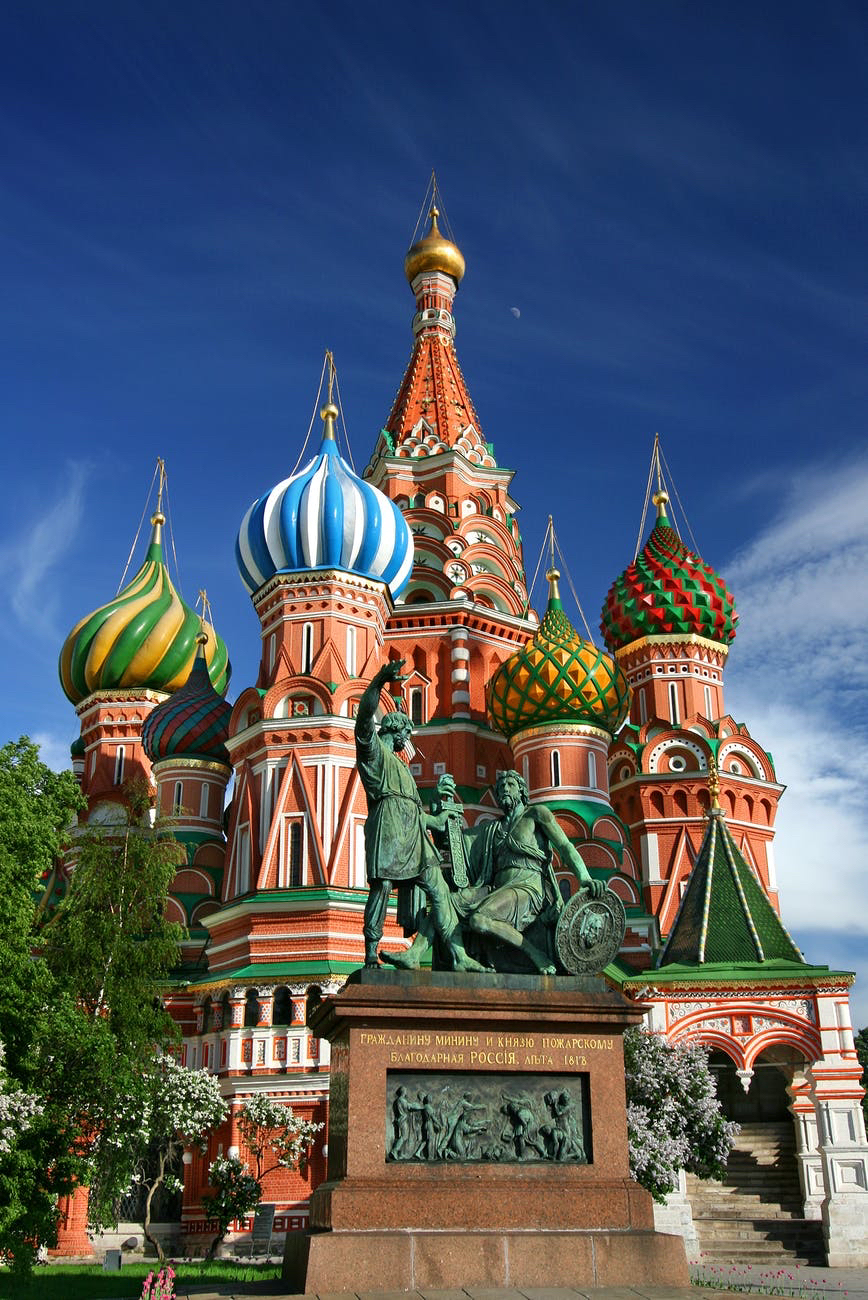
The ornate, colorful domes of St. Basil’s Cathedral to our left, we stood in the center of the Square facing the tomb of Lenin, revered founder of the U.S.S.R. Upon his death in 1924, Soviet leaders built the mausoleum soon after and laid him permanently in state, where his body remains eerily preserved to this very day. While I can’t verify it, it is rumored that nails and hair are regularly trimmed when the body is not on display.

After a brief discussion, we determined who among us was brave enough to venture into the tomb. There was no question about it for me, having heard about this very monument and having learned a thing or two about Lenin and his role in Soviet history. It was an opportunity I couldn’t pass up.

So, we queued up and began the slow, deliberate shuffle toward the entrance. As we neared admittance, we understood that we were to remain silent, were to capture no photographs, and were to remove our hats. I dutifully complied as we began to make our way past the guards, one posted on each side of the threshold. As I began to cross, the guard to my right reached out his arm in front of me, I assumed to look me over first for photographic equipment. He then lowered his arm, allowing me to pass, and so I did. Placing my hands in my jacket pockets, I proceeded to move forward only to be jerked backwards by my right arm. I turned and found the same soldier angrily address me in his native tongue. I never determined what he said, but his incensed tone communicated everything — take your hands out of your pockets. I failed to receive these instructions beforehand, but I was nonetheless allowed to pass once I demonstrated I understood. Once again, I was left with the harsh impression that there are no comedians in the ranks of the Russian military.

Recovering from this shock and reprimand, I stepped inside and wound around the inner perimeter. There, in the center of the marbled, rectangular room, was the body of Vladimir Ilyich Ulyanov, a.k.a. “Lenin,” lying protectively in a glass-encased container the size of a coffin. Guards stood stoically posted at all corners of the interior, ensuring respect was maintained by all who entered. The palpable silence, armed military presence, and dim atmosphere endeavored to communicate to all exiting that you have been in the presence of a god, albeit a dead god. While a day never transpired before or after in which Lenin crossed my mind, it nonetheless made an impression on me, not for the importance of this man but for the misplaced reverence of those following who paid sustained posthumous respect to him — a man whose Revolution that birthed a “united” country fell apart in less than a century.

The following day, we departed Moscow and boarded a dual-propeller Aeroflot passenger plane, bound for our final destination and new home — Lugansk, Ukraine. The noise and jarring revolutions of the engines, I discovered, ensured that conversations were maintained at a minimum of 90 decibels and that the fuselage alarmingly creak under the strain before, during, and after the flight. Somehow, we arrived intact and made our last few kilometers into town, uncertain of the stories we hoped to tell one day to those we left behind.

The news of late has shared no shortage of stories tragic and unsettling of this region over the course of the year. The stories, however, that we have been able to tell of that year in our lives there have remained with us and became an inseparable part of our identities. This first leg of the journey, lasting only a few days, left me with more than my share of impressions. I hope and expect to say more about all that followed in the future as time an inspiration permit. In the meantime, I simply pray that peace will once again find its way to Ukraine, a place we once gladly called home.