London

Once upon a time, my wife and I were DINKs. For those who don’t know, that stands for “Dual Income No Kids.” It’s a very comfortable life, I will admit, and a very appealing option. I judge no couple for choosing it, but do note how vastly different it is from the choice to have or bear children.

Once upon a time, Jenny and I also had the opportunity to do one of our favorite things, which is travel together abroad. This coincided with our DINK lifestyle, prior to children. She periodically continued to travel for work after the kids, but it wasn’t quite so much fun since one of us (i.e., me) had to stay behind with them. C’est la vie.

One of our last trips abroad as DINKs was to London, right before the kids entered our home and altered our status forever, back in the spring of 2016. We thoroughly enjoyed it, even as we had no idea how thoroughly life was about to change.

And here we are again, providing the kids with one of their first sojourns across an ocean, once again in London. It feels full-circle, especially when we consider that our oldest is potentially leaving the nest here in her last year of public school. It feels like an accomplishment, not only for her but for us as well, when you think about where they began.

I acknowledge you’re never really finished with the job of parenting, but there are a few satisfying stages I still hope to cross, this being one of them. All the more meaningful when you consider, even if they don’t yet, where they’ve been and how it could easily have been a different outcome for them.
Kids are a form of chaos. It’s true — don’t try to deny it. Navigating the critical stages may feel like a cakewalk, or more likely a turbulent off-road adventure. It depends on the kid. Regardless, it will require effort on your part, not to mention sacrifices on your part, which they may or may not acknowledge. Lack of recognition is part of the job, unfortunately, that I daily try to swallow and simply move past.

But here and now, seemingly full-circle in a country with all the kids we once were about to take on, I feel a glimmer of accomplishment and hope, which is fleeting and temporary at best in the day to day job of parenting. They may have no idea about either in the ignorance of adolescence, but I can see it clearly 9 years into the job, as one of them happily prepares to move on, and seemingly happy to be here with us, still calling us mom and dad.

The satisfaction of completing challenges take many forms. Parenting, adoptive or otherwise, is its own special form, I will tell you. We’re still in the thick of it, but I think I will remember the two trips to this specific place as a couple of bookends, from the uncertainty of the task ahead, to a stage of the task fulfilled, regardless of whether or not it looks exactly like I imagined.

Before and after

Snow Stories

The first fall of snow is not only an event, it is a magical event. You go to bed in one kind of world and wake up in another quite different, and if that is not enchantment then where is it to be found?

– J. B. Priestly

“Is This Your Mattress?”

Small-town newspapers struggle for stories worthy to print, I’m sure, and the Malone Telegram was no exception. This uninspired front-page headline was accompanied above the fold by a far too prominent black-and-white photograph of a filthy, well-used mattress deliberately dumped roadside by an unknown offender, a reprehensible act, the article alleged, that was becoming all too common a petty criminal custom in a town where virtually everyday was a slow news day — except, perhaps, for the time a rogue buck dashed confused and rampant through the steeply inclining and declining streets of the center of town, clearly having taken a wrong turn out of the surrounding woods. There wasn’t much to recommend to outsiders the little town of Malone in the North Country region of New York; unless, that is, dairy farms and state prisons get your motor running.

Following our year-long adventure in post Soviet-era Ukraine, our family moved in late 1993 to this section of the country that felt, at that time of year, more like the frozen, bleak, and lonely edge of the earth to those of us who hailed from the humid, sunny, and densely-populated outskirts of Houston, though, I will admit, the changing colors of the fall there are a sight to see. The weather, which introduced us to show-stopping snow and ice and the acquired skill of winter driving, wasted no time introducing us to the change of scenery, as we walked unbeknownst into one of the heaviest snowfall seasons on record.

Arriving from Houston (via Ukraine), we knew well that snow was an extremely rare event, having grown up in a section of the country better known for its blistering heat and humidity, though the winter before in eastern Europe had provided us with ample opportunity to experience bone-chilling cold and precipitation that lasted more than a day. While it was common enough there not to write home about, it was uncommon to us Houstonians, and we took advantage of snow and ice on more than one occasion to keep ourselves entertained.

One of my first introductions to the thrill of sledding taught me a lesson about staying aware of what lies beneath, so to speak. In the small village of Metalist, north of the sprawling city of Lugansk, where our family resided, lived another missionary family we would visit from time to time. Incidentally, a recent search on Google Maps for this nondescript location yielded pictures almost solely of the town in winter, as if to suggest it’s the only time of year that would occasion a photograph. One of the families we would visit lived in a small house near the edge of town, and next to this house was a decent hill, ideal for sledding, and each of us took advantage of the opportunity, many of us for the first time since most of us hailed also from the Texas Gulf Coast.

My turn came soon enough, though it was clear after a few runs that the snow had not sufficiently settled or packed itself in, resulting in a rough but rapid ride on the way down. Moreover, the terrain beneath was not without its obstacles in the form of rocks, which, it would seem, was hardly sufficient reason to end the show for all of us thrill-seekers gathered. As I took my place on the sled, pushed off, and began the descent, all was otherwise well until I lost control at the bottom, flying off and landing not comfortably prone into a soft cushion of white powder but onto my knees into a concealed patch of unforgiving rocks beneath the deceptive fluff. I should add that it was not my rock-like kneecaps that took the brunt of the impact but that tender space just beneath them — that is, between patella and tibia. How I got up, I don’t know, but to say I was in pain was an understatement. Kids are resilient, they say, and I suppose 16-year-olds are as well, since I found a way to carry on until the bruising and discomfort subsided over the next several days. I know for a fact my 200 pound, 48-year-old body would have left me on the ground writhing from such an injury, waiting to be carried mercifully to the ER, yet here I am upright and ambulatory, able to tell the tale decades later.

My brother, sister, and I had another winter habit, almost equally risky, during our sojourn in Ukraine, specifically in the small triplex we called home for a few months. It’s no secret that water turns to ice in the frigid air, so, in the absence of snow, we would clear a substantial patch of ground in the “garden” space of the enclosure outside of our triplex and generously dump buckets of water onto the cold, barren dirt, waiting for the temperature to create for us our own mini ice rink. And so it did, after a day or so. Miraculously, no injuries were sustained from the hours we spent sliding along the icy patches. I’m not sure there’s a lesson there other than learning how to maneuver successfully on slick surfaces without a fatal fall, or, perhaps, finding creative ways to keep oneself engaged in the absence of entertainment being handed to you.

Our return to Texas in the summer of 1993 might have been the last we experienced a winter wonderland if not for our move to New York state towards the end of the year, as mentioned above. My parents left the mission field across the ocean after an illness and emergency surgery sustained by my mother there brought us back home. Months later, they would accept the pastorate of a small church in the little town of Malone, only minutes from the northernmost border shared with the French Canadian province of Quebec. It might as well have been another country for the differences between us and the citizenry, arriving from about as far south in the country as you can travel, to almost as far north, save Maine and Alaska. We were relative foreigners by contrast, unique in speech, background, and, especially, faith, my parents having taken on the task of shepherding a very modest congregation of Evangelicals in a predominantly Catholic community. I learned first-hand just how odd the five of us appeared to the locals one morning after I seated myself in my first period class near the beginning of my junior year and overheard a classmate remark to another, upon understanding that my father was a “priest,” “Doesn’t that make him illegitimate?”

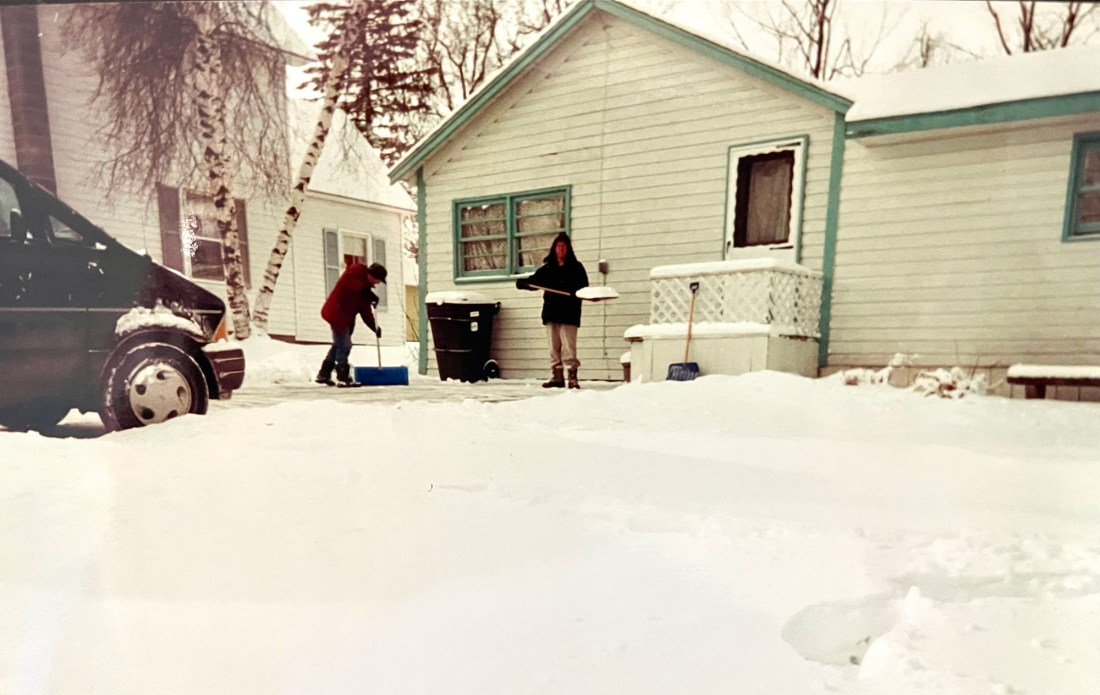
I would remain only long enough to graduate, returning to Texas for college at my first opportunity, but would return for the next seven years during summer and winter breaks. Our first winter, in 1993, pulled no punches and, we learned, would be one of the heaviest experienced in several years. We shoveled snow out of the driveway on a regular basis, acclimated to the sub-freezing temperatures enough not to require heavy attire while doing so, and became well-versed in traveling on the slick roads. One particular steeply-inclined street leading from town up to our parsonage across from the middle school required drivers to build up enough momentum beforehand to reach the level peak rather than slide perilously backwards, in order to try earnestly once more.

My brother, sister, and I made the most of it, however, and I wouldn’t hesitate to say we were each others’ best friends, having learned overseas how to keep ourselves entertained, especially in the cold. I had mentioned that the winter we arrived ended up one of the strongest in many years. I hadn’t the experience to know any different, but I do know that halfway through the season, the piles of snow my father, brother, and I had shoveled out of the driveway and into the yard were taller than me. This fact gave us the interesting notion of occupying ourselves by digging out meandering “trails” in the snow around our yard, which we labored to complete over a day or so. To cap it off, the largest snow-shoveled “hills” we mined, so to speak, creating our own tiny igloo in which to hide. The trails surrounding the modest acreage served as a makeshift racetrack, each of us competing for the best time start to finish.

The only thing more marvelous than the measured snowfall were the icicles. Varied warming and freezing over the season created, at times, fantastic ice columns that stretched from roof to ground, wonderful to observe but, as kid/teen, even better to break apart or use as a tool, yard decoration, or imaginary weapon. Problem with the latter, while an impressive lance, is that it doesn’t hold up to actual swordplay, shattering at first strike. No matter, though. It’s fun and satisfying to break stuff without serious consequence too.

Other than our front yard, the high school football field offered another playground in the form of a perfectly-inclined and distanced hill for sledding. We took the opportunity only a few times since it was not within walking distance to the house and required a drive, its own challenge due to yet another road that necessitated gathered momentum in order to safely arrive at the top. During one particular trip, we met a few of the other youths in the church there and after a number of up-and-downs decided to get creative, building a natural, hastily-constructed ramp at the bottom. Not one of us, I should note, were engineers or had a mind for such, which would soon become evident. Our willing guinea pig was one of the younger kids, who topped the hill, straightened up, and, when given the signal, charged down. We all prepared for a successful outcome as he neared the ramp. Unfortunately, while there was airtime achieved, our ramp revealed itself more as an idiotic obstruction, and said kid, rather than smoothly gliding forward through the air, instead hit the “ramp” like a pilot performing an emergency ejection from a fighter aircraft, shooting violently upward rather than outward. Thankfully, the snow was there to cushion his jarring, flailing tumble back to earth, though we all held our frosty breath for a moment, hoping, as he lay motionless, that we had not just killed a kid. He rose after a moment, to our relief, though I don’t recall that he ascended the hill for another go.

As much fun as the cold can bring, it offers more than its share of inconveniences. I would be remiss not to retell one final tale, regarding the storied ice storm of January 1998. While on winter break from college, my brother and I nearing our return to Texas, temperatures warmed just enough over a couple of days to create freezing rain, which cakes everything on which it lands in ice. Given enough of this, the collected ice begins to allow gravity to do its work and pull whatever its landed upon more forcefully toward the ground. This might not be an issue were it not for suspended tree branches and power lines. If the latter doesn’t snap under the weight, the former will make sure that it does. And so, at some point in the night, while you hear the tired and heavy branches fall heavily to the ground all around you, the power disappears, taking the cherished and necessary heat in your home along with it. Five counties across the North Country were affected, and the National Guard eventually rolled in while we hunkered down for days in my parents’ upstairs bedroom, the warmest room in the house, which wasn’t saying much. It was difficult not to sympathize with the close quarters endured by the Anne Frank family, and we oddly acquired some idea of what it was like to feel trapped in a tight space as if hiding from danger. In due time, we were able to make our way to the home of friends whose power was restored in another part of town, and there we were until it was restored to our own. While inconvenient and uncomfortable at the time, it’s still a story we happily tell, and one that deserves an equal place on the shelf with all of the others, favorable or unfavorable circumstances notwithstanding.

I could say that I regret we don’t live in more frigid regions so that our kids are able to create more of their own favored memories of snow and ice, but I would be lying. The truth is, it doesn’t take long to wish it on its way and long for warmer spring temperatures. I am grateful, however, for the times they have been able to experience it, such as these last few days, and form their own stories. A fresh blanket of snow, to me, always arrives as a natural, blank canvas like nothing else there is in life, inviting you to trudge, play, or just provide visible evidence that you’ve been here, that you’re simply happy to be alive.