“The truth is out there.”
I wonder if any devoted “X-Files” fans found it curious, during the forgettable year that was 2020, that when the government itself acknowledged in long-awaited declassified reports that they had, in fact, collected and documented evidence for decades of UFOs, the world generally took little notice or interest. Maybe it speaks to the incapacity of many of us to be truly impressed or surprised by anything anymore. It seems the truth was, in fact, out there, as the show once pitched weekly following the opening credits, but we moved on, treating the news no differently than if we had exited the theater, venturing from fiction writ large on a screen only to return to mundane reality. Maybe it’s just as well. It seems the official evidence presents nothing more than harmless, flashing objects evading pursuit and performing bizarre aeronautical feats before vanishing from sight. It’s possible to enjoy similar entertainment at the annual air show. Watching agents Mulder and Scully uncover the mysteries of the paranormal or investigate closely-guarded government secrets of alien existence in the space of an hour is, arguably, much more intriguing.
Many episodes diverged from this overarching storyline and had a bit of fun as stand-alones. While I didn’t spend time with the series from start to finish, one of my personal favorites is a season seven tale titled “Je Souhaite.” Long story short, the agents investigate a centuries-old jinniyah (i.e., genie) in the form of a woman who appears just as human as you or me. Hijinks ensue. A more memorable moment towards the end of the episode finds Agent Mulder chanced with a turn to offer three wishes of his own. Pausing a moment so as not to squander this rare opportunity, he opts for the high-road with his first wish, nobly and altruistically requesting peace on earth. The jinniyah routinely and disinterestedly complies. The wish is answered not with a bang but a whimper as an unsettling silence descends. The white noise of traffic and city bustle is eerily and suddenly absent. Peering out of the window, Mulder observes that all living things, with the exception of him and the jinniyah, have vanished from existence. Her vast years of experience with humankind have afforded her interpretive privilege, and the outcome of the wish clarifies her position: You can’t have both peace on earth and people, whose hearts are what they are. Pick one or pick the other.
If you were to ask me on any given day what I want most out of the forthcoming 24 hours, if I dug deep, I would likely respond with the word “peace” or some version of it. Peace in the schedule, peace at work, and, most of all, peace in relationships. I wasn’t bred well for conflict, but I wouldn’t dare attribute that to a failure on the part of my parents. I’m less critical of parents generally since I’ve been one.
In any event, I have been know to pursue harmony in tense encounters at times the same way an addict will cut corners to sate a craving and settle his mind and body. It’s a fault of mine, I know, but there you have it. I’ve managed to make it in life agreeably with most I encounter, though the character flaw has, ironically, been the cause of tension in a handful of moments in spite of efforts to avoid it. It seems some aren’t afraid of it but actually seek and create opportunities for conflict. My children, or at least one of them, are just such persons, though they are good kids overall. Nonetheless, I find God must have a sense of humor when I consider that he’s paired the three of them with me.
My perspective since having children has broadened significantly as to what is at one’s disposal about which to disagree passionately. Clothes, food, toys or other cherished possessions, you name it, they’ll argue over it. I once listened to a long, anguished, tear-stained altercation develop in the backseat of our van between two of ours over the rightful owner of a common — wait for it — rock. Yes, you read that right. They were both committed to dying on that hill, doubtless made of innumerable figurative stones equally as common. It was at that moment I knew I had now heard it all, and it remains the only time in my life I’ve felt the impulse to throw myself out of a moving vehicle.
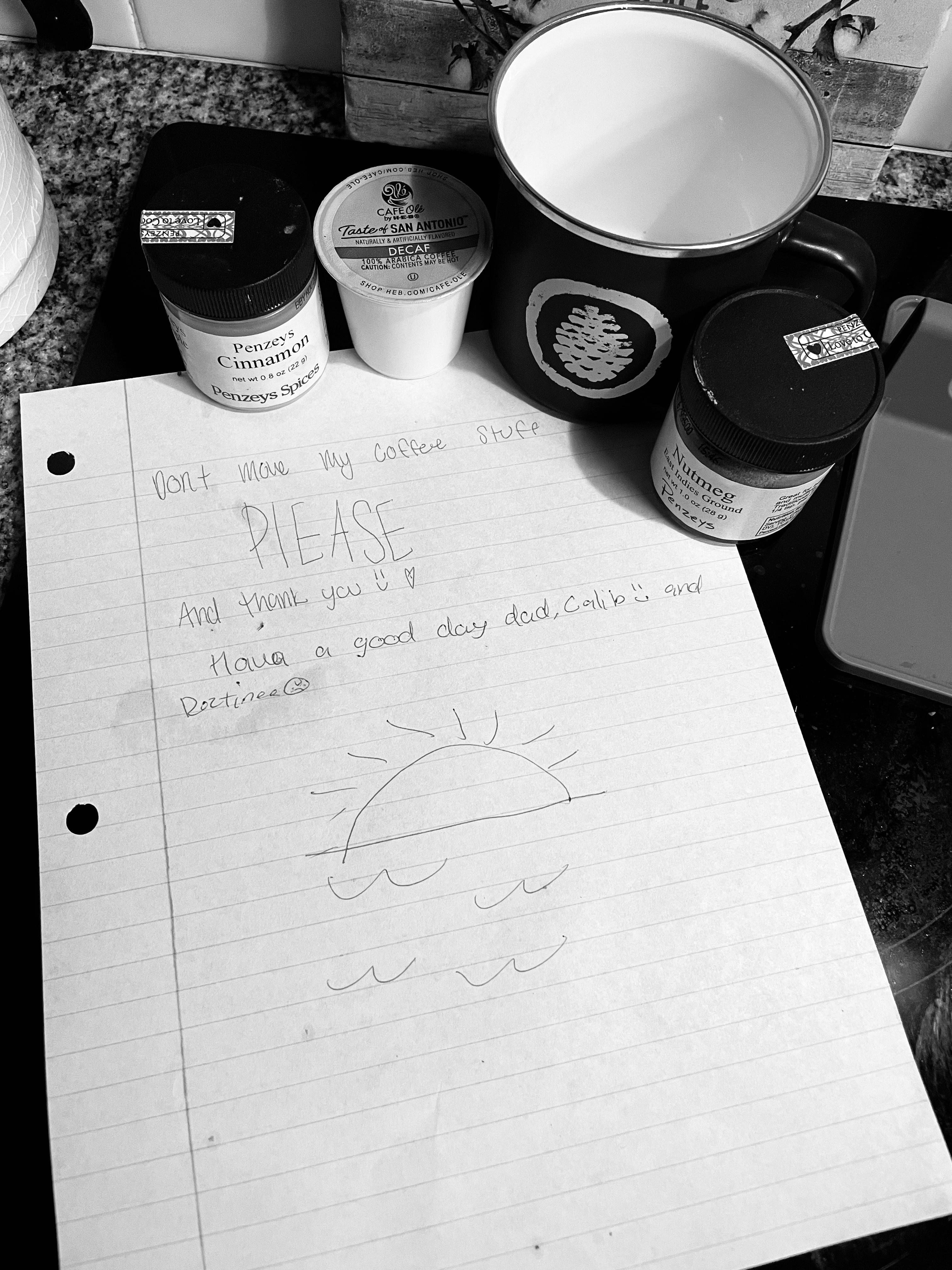
Recent battles between our oldest and middle have assumed the form of a blame-game I would refer to as “Who Ate the Last of the _______?!” The winner is typically our oldest, who couldn’t care less about her alleged victories but is forced to play by our middle, who, of late, has taken to labeling items and carefully crafting and depositing notes in various locations around the kitchen and pantry to serve as reminders of what she is convinced is hers. She still hasn’t caught on that she makes no actual food purchases herself and has no rights or claims on what is or isn’t consumed, in spite of our own reminders, though I will admit our teenager, like many adolescents gifted with rapid metabolisms, has a unique talent for disposing of communal food as if it were a sworn duty. Nonetheless, we find notes like the one I discovered on the stovetop after rising early to get myself ready along with the other two (see below), who head to school at least an hour before her. It was the first note in my memory that made an attempt at polite acknowledgement of who owns what, merely, I should say, by virtue of the included words “please” and “thank you.” The rest was a blessing, of sorts, juxtaposed with a subtle, almost hidden warning, signified by a smiley-face and not-so-smiley face each deliberately placed next to two specific names in judgment. Apparently, one does not gracefully forgive and forget the previous month’s ice cream “theft.”

This is relatively mild by comparison. Early interactions overall at the beginning of our adoption journey were exhausting and challenging, to say the least. It’s hard becoming a family formed by adoption, especially if your kids have memories of life before you. Not too long ago, the movie “Instant Family” was released, and while my wife and I rarely take the time alone to go to the theater, we found space for this one. For those unaware, the story tells of a couple who choose to adopt three older siblings, ranging from preschooler to teenager. It fashions itself as a comedy, but the two of us viewed it almost as if someone had been reading our mail. Yes, much is exaggerated, but much also felt uncomfortably close to home. For a span, my 15-second elevator-pitch when someone asked what it was like to foster-to-adopt three children, I would refer them to this movie and tell them to catch up with me later if they had any further questions. While the conflicts depicted there are not as focused on what happens between the siblings, the tension and struggles are just as palpable. “We didn’t train for this!” Mark Wahlberg’s character exclaims during the chaotic dinner table scene. Such a sentiment I’ve felt time and again for the gamut of adoptive family-building, especially when navigating moments of sibling rivalry and conflict. Fortunately, my faith has provided a little transformative help.
If you’re a parent and a believer, you likely witnessed that the way you read Scripture altered significantly after kids came along. The stories in Exodus alone, for example, often read like stubborn, spoiled children who simply can’t quit complaining on a long road trip. They’re pleased to accept the benefits, but they’re also soft and ungrateful, unable to endure discomfort in any form. In the few spaces when Moses steps in to stay God’s hand on the disgruntled Israelites’ behalf, the parent in me is anticipating and hoping for a thorough smiting and wants to shove Moses aside to let Dad take care of it.
Take a step back to the book before it — the very first in Scripture, I might add — and after reading you might find one could make a convincing argument that the narrative of Genesis and, by extension, the purposes of God, were largely driven by sibling rivalry. Maybe you haven’t noticed, parent, but it may provide you a hint of hope to know that it all started right there at the very beginning, and it happened time and again. You’re far from alone in the human experience of bringing up bickering babies. What you deal with, what you referee day in and day out, has been going on since recorded history began, and, it seems, was the impetus for moving many things along.
Of the 1,189 chapters in Scripture, we’re barely getting started when we come across the story of Cain and Abel in the fourth. Like many conflicts, jealousy and the attention and approval of a parent (i.e., God) are at the center. The result of the bitterness, as we know, is the first murder. “Well,” I think to myself, “mine haven’t avenged themselves in such a violent manner; perhaps I have little to complain about, after all.” And I wouldn’t be wrong; but let’s keep reading.
Isaac may have been the promised child of Abraham and Sarah, but it’s easy to forget about Ishmael, his literal brother from another mother. If we believe Sarah and our translators, Ishmael, the older of the two, saw fit to “mock” the younger half-sibling on the day he was weaned. Sarah was none too pleased, and when mom ain’t happy, ain’t nobody happy, as the saying goes. The first parent in known history to establish an anti-bullying campaign, she coldly issued Abraham orders to cast mother and son out of his household, to which he assented only after assurance from God that they would be taken care of. The Ishmaelites would later become the early tribes of the Muslim faith and would quietly live out their days to the present in relative peace and harmony with the rest of the world . . . except that they haven’t. It’s as if the youthful fraternal animosity that served as cause to be cast out would thereafter characterize a people and faith in their relations with their cultural brothers and neighbors.
Then we meet Jacob and Esau. Now, this is a classic rivalry for the ages. These twins exited their mother’s womb veritably as discord defined, though, to be fair, Jacob duly bore much of the credit for that, especially throughout their early relational history. For those of us who blame our lack or misapplication of nurture as parents for the negative traits our kids exhibit, here is an example of nature trumping nurture. Jacob was granted the name “supplanter” or “deceiver” as soon as the curtain rolled up by virtue of the odd obstetric fact that he “grasped the heel” of his brother on the way out, as if to presage his methods would hereafter involve the unwilling and forced assistance of others in order to get his way. We know the story of Jacob stealing both his brother’s birthright and later “pulling the wool” over his own father’s eyes to swipe his brother’s blessing. This guy later had the gall to wrestle with God himself and stubbornly refuse to let go after they encountered a stalemate until he got what he wanted. I wonder that clinicians today might diagnose that as a penultimate case of oppositional defiant disorder, which, nonetheless, was the spark that resulted in the birth of Israel itself.
Then there’s Leah and Rachel, lest we forget it’s not only about the boys. Prior to his wrestling match, Jacob fled the wrath of his brother, decided to settle down, and was forced to toil a number of years for these two sister wives as a result of duplicitous tables turned upon him for a change. And in case we needed a demonstration as to why polygamy is a terrible idea, here we’re treated to a vigorous birthing competition between the sisters. When they ran out of steam, so to speak, they threw other women in their charge at him, and this all for the sake of “winning.” Throughout this narrative, Jacob/Israel becomes less the progenitor of a nation and more of a prop for the sisters’ bitter rivalry. Such a twisted tale nevertheless produced the nation’s twelve tribes, which would serve as the basis for Israel’s multi-faceted identity throughout the rest of its history.
Finally, we have Joseph and his brothers, whose story is given the greater share of space in Genesis. Our children accuse us of having favorites, though the truth, or at least what I tell myself, is that we relate to them differently based on their personalities. These siblings, however, knew full well the little runt was dad’s favorite. Consumed but united by their jealousy and incense at his arrogant dreams, they went so far as to throw him down a well and then sell him into slavery to strangers, though their original plan involved ending him once and for all. Unbeknownst to dad, they brought back false evidence of an animal attack and let him believe the lie that cruel nature had claimed his life.
One of my cherished observations about Scripture is that it doesn’t whitewash human shortcomings and failures. It’s ugly, unpleasant, and heartbreaking, and in my opinion, serves as strong and persuasive testimony that it’s telling the truth. It doesn’t over-employ the best qualities of its characters to convince you. To the contrary, we see the best and and the worst together, much like our own lives, and we find we can relate. My kids and yours may not have committed quite so atrocious acts against one another, but we’ve personally witnessed the same feelings motivating them to do whatever it is they do to or for each other.
I want my kids to do well, but I more often pray that they choose to be kind. If such things start at home, frankly, it’s difficult to tell where we might be in the process. Just last night there were bitter, vicious words exchanged over simple drinks spills, whereas days before they were happily sharing their devices because they “love each other.” I’ll happily take the latter, but more often than I’d like, I see the former. On the other hand, they haven’t stooped to murder in the first, mocked each other to the point of forced exile from the home, fled the house in fear because of deception, birthed a bunch of babies to earn a man’s favor, or conspired to sell one of the others off to strangers but tell us and God that he/she died. So, I guess we’ve dodged a bullet. So far.
We still worry, though, each time we see less than what we hope for in their characters. But here’s the beautiful thing about this first book and the reason Joseph’s story was deliberately reserved for the end, I think. After all that — and I don’t mean his story alone — after all that was endured in almost 50 chapters prior, after every instance of siblings threatening not only each other but the plans of God himself and, I would argue, their parents’ deepest hopes for them, we hear Joseph’s refreshing words: “. . . you meant evil against me, but God meant it for good.”
“The art of living is more like wrestling than dancing,” said Marcus Aurelius. I don’t know if the esteemed Roman emperor was familiar with the story of Esau’s brother, but, perhaps, despite all his character flaws, Jacob was unwittingly onto something as he stubbornly struggled and strained against God himself that evening on his way to reconcile with his twin. If so, maybe I shouldn’t fret too much about the backseat bickering, as tame or terrible as it might be. God is aware of what he’s doing with my kids, even if I don’t. I’ll still strive to encourage peace between them in our modest corner of the earth, but if Genesis has anything to teach us, it’s that even the the most vengeful of sibling rivalries can’t thwart the purposes of God. He’s got it in hand; there’s no need for a genie with a handful of wishes.

 Time in a Bottle
Again, so true!
Sent from my iPhone
>
LikeLike